12 Essential 3D Printing Accessories (2027): Dryers, PEI Plates & Tools
Skip useless upgrade kits. Discover the 12 essential 3D printing accessories for 2027—from active filament dryers to PEI plates—that stop print fails.
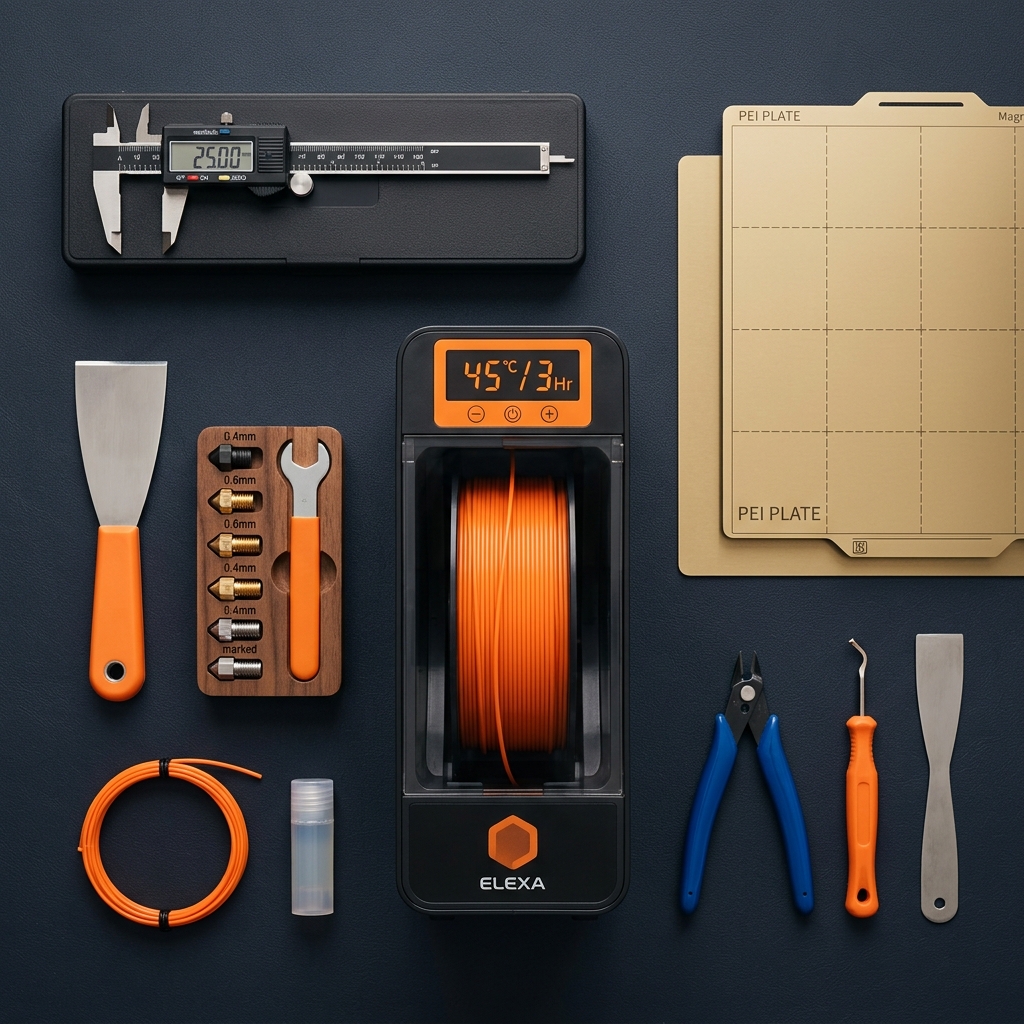
- ✓ #1 Highest-ROI Accessory: An active heated Filament Dryer ($39–$129) eliminates stringing, steam popping, rough outer walls, and brittle spool snapping.
- ✓ #2 Essential Day-One Tool Kit ($42 total): A 6-inch stainless digital caliper, swivel deburring tool, flush micro-cutters, and 99% Isopropyl Alcohol spray bottle.
- ✓ #3 Zero-Energy Adhesion Upgrade: Polyurea "Cool Plates" (like BIQU CryoGrip / Bambu SuperTack) hold PLA at a 35°C–45°C bed temperature, cutting printer electricity draw by 40%.
- ✓ #4 Engineering Material Readiness: Never print Glow-in-the-Dark, Carbon Fiber (CF), or Glass Fiber (GF) filament through a brass nozzle—upgrade to a 0.4 mm or 0.6 mm Hardened Steel nozzle first.
- ✓ Every prevented 350-gram print failure saves ~$6.50 in filament and 6 hours of machine wear—meaning a $95 accessory bundle pays for itself within 15 saved prints.
Stop Buying Gimmick Mods: Invest in Reliability & Yield
In 2020, buying a budget 3D printer meant immediately ordering $120 worth of replacement extruder arms, stiffer yellow bed springs, glass plates, and octoprint Raspberry Pi boards just to get a reliable first layer. In 2027, modern machines like the Bambu Lab A1, Bambu Lab P1S, and Creality K1C ship fully calibrated out of the box—which means most "printer upgrade kits" sold online are obsolete clutter.
Instead, the smartest investments you can make in 2027 are workflow, moisture-control, metrology, and surface-adhesion accessories that slash your print failure rate from 10% down to under 1.5%. Remember: a single 400-gram functional print that detaches from the bed at 85% completion wastes $7.20 in filament, $0.35 in electricity, and 8 hours of machine availability. You can browse our full hardware ratings in the 3D Printing Accessories Catalog and see how failure rates change your part cost in our 3D Print Cost Calculator.
Tier 1: The Day-One Workbench Essentials (Under $55 Total)
Before you buy exotic nozzles or multi-spool dry boxes, equip your workbench with the five core hand and measurement tools that every maker uses on virtually every single print job.
1. 99% Isopropyl Alcohol (IPA) Spray Bottle & Microfiber Cloths (~$9)
The #1 cause of first-layer warping and spaghetti failures in 2027 is invisible human skin oil (sebum) transferred from your fingertips onto the PEI build plate when removing the previous print. Keep a fine-mist atomizer bottle filled with 99% Isopropyl Alcohol next to your printer and wipe the cold plate before every job. Every 15 to 20 prints, carry the spring-steel sheet to the kitchen sink and scrub it with plain dish soap and warm water to remove accumulated PLA sugars that alcohol alone only spreads around.
2. Rotary Swivel Deburring Tool + High-Speed Steel Blades (~$11)
When you print a mechanical part with a brim or a slight first-layer squish ("elephant's foot"), trying to trim the bottom edge with an X-Acto hobby knife is a recipe for gouged plastic and sliced fingers. A machinist's swivel-head deburring tool glides along curved inside holes and straight outer edges in one fluid motion, leaving a clean 45-degree chamfer in three seconds.
3. 6-Inch Stainless Steel Digital Caliper (~$19)
If you ever design replacement household parts, calibrate filament shrinkage, or check why an M3 bolt hole feels tight, a 150 mm (6-inch) stainless steel digital caliper with 0.01 mm resolution is mandatory. Use its outside jaws to verify 20×20 mm calibration cubes, its inside jaws to check bearing bores, and its depth rod to verify counterbore depths.
4. Flush Micro-Shear Cutters & Needle-Nose Pliers (~$8)
Never load flat-cut filament into an extruder or AMS hub—a blunt 90-degree tip catches on PTFE tube chamfers and Bowden couplings. Keep flush micro-cutters clipped to your spool rack to snip filament ends at a crisp 45-degree bevel and nip away delicate tree support branches.
5. 5kg Digital Gram Scale with 0.1g Precision (~$12)
How many grams of filament are left on that half-empty black PETG spool? Weigh the spool on a 0.1g digital scale and subtract the empty spool tare weight (typically 145g for cardboard spools, 200g–250g for reusable ABS spools). You can also weigh finished parts to verify slicer estimates for our Cost Calculator.
| Rank & Accessory | Typical 2027 Price | Primary Problem Solved | Payback Threshold |
|---|---|---|---|
| 1. Active Filament Dryer (1–4 Spool) | $39 – $119 | Eliminates wet-filament stringing, popping, zits & brittle PLA | Saves 2–3 ruined spools |
| 2. 99% IPA Spray + Microfiber | $9 | Prevents fingerprint grease bed detachment & spaghetti failures | Saves 1 failed print |
| 3. Swivel Deburring Tool Set | $11 | Removes brim edges & elephant's foot cleanly in 5 seconds | Immediate labor savings |
| 4. 6-Inch Stainless Digital Caliper | $19 | Measures tolerances, bolt holes & flow calibration to 0.01 mm | Saves 2 prototype iterations |
| 5. Flush Micro-Cutters & Pliers | $8 | Cuts 45° filament tips & removes tight tree supports | Day-one convenience |
| 6. 0.1g Digital Gram Scale | $12 | Tracks remaining spool grams & verifies real part weights | Saves 1 mid-print runout |
Tier 2: Moisture Control & Active Filament Dryers
If there is one hardware secret that separates frustrating hobby printing from effortless 99% print-farm reliability, it is active filament drying.Read our material moisture guide in the 3D Printer Filament Hub.
6. Why Even Brand-New Vacuum-Sealed Spools Arrive Wet
Many users assume that because a spool of PETG or Silk PLA arrived vacuum-sealed with a tiny 5-gram silica gel packet, it must be bone dry. In reality, during industrial filament manufacturing, molten plastic is extruded out of the factory die at 210°C and immediately pulled through a 4-meter-long cooling trough filled with liquid water before being wound onto the spool. That tiny desiccant packet prevents further condensation during ocean freight, but it cannot pull bound moisture out of the polymer matrix without heat.
When hygroscopic polymer chains containing >0.15% moisture hit your 235°C nozzle, two destructive things happen simultaneously: (1) microscopic pockets of water flash-boil into steam at 100°C, creating audible popping sounds, crater pockmarks on outer walls, and foaming wispy strings; and (2) hydrolytic chain scission slices long polymer molecules into shorter chains, reducing tensile layer strength by up to 30%.
7. Single-Spool Dryers (Creality Space Pi) vs 4-Spool Dryers (SUNLU S4)
- Single/Dual-Spool PTC Dryers (e.g., Creality Space Pi / Space Pi Plus, ~$46–$69): Uses an active 48W–80W PTC ceramic heater and circulation fan with a touchscreen timer (45°C to 70°C) and PTFE feed ports so you can print directly out of the heated chamber. Ideal for single-extruder setups like the Creality Ender 3 V3 KE or Elegoo Neptune 4 Pro.
- 4-Spool Multi-Color Dryers (e.g., SUNLU Filadryer S4, ~$119–$135): Holds four 1 kg spools simultaneously with a 330W PTC heater, triple circulation fans, and an automatic humidity trigger that kicks on whenever internal RH exceeds 25%. It is the #1 companion for open multi-color systems like the Bambu Lab A1 Combo (AMS Lite).
Filament Drying Temperature & Duration Reference
- PLA / PLA+ / Silk PLA / Matte PLA:
50°Cfor 4 to 6 hours (Never exceed 55°C or PLA softens on the spool!) - PETG / Rapid PETG / PCTG:
60°C to 65°Cfor 6 to 8 hours - TPU 95A / 85A Flexible:
55°C to 60°Cfor 8 hours (essential for zero-stringing flexible prints) - ABS / ASA:
65°C to 70°Cfor 6 to 8 hours - Nylon (PA6 / PA12 / PA-CF):
75°C to 85°Cfor 12+ hours
Tier 3: Build Plates, High-Flow Nozzles & Energy/Safety Gear
Once your hand tools and filament drying are dialed in, these five hardware upgrades unlock abrasive engineering composites, glass-smooth bottom finishes, and lower power bills.
8. Dual-Sided Textured PEI + Smooth PEO/PEX Spring-Steel Plates (~$22)
Stock textured PEI plates are tough workhorses, but having a spare dual-sided magnetic spring-steel sheet lets you swap a finished plate off the printer in 5 seconds and start the next job immediately while the first plate cools on the counter. Smooth PEI/PEX sides also yield mirror-flat mating surfaces for glued enclosures.
9. Low-Temp Polyurea "Cool Plates" (BIQU CryoGrip / Bambu SuperTack, ~$28)
One of the biggest material breakthroughs of 2026–2027 is the micro-porous polyurea Cool Plate. Traditional PEI plates require heating the aluminum bed to 60°C for PLA; if power flickers or a corner catches a draft, the part warps off. Polyurea plates chemically and mechanically lock onto PLA and PETG at a bed temperature of just 35°C to 45°C—cutting printer electricity consumption by up to 45% and eliminating corner warping on large flat boxes!
10. 0.4 mm & 0.6 mm Hardened Steel / ObXidian Nozzle Kit (~$24)
If your printer came with a brass or 300-series stainless steel nozzle, do not run Carbon Fiber, Glass Fiber, or Glow-in-the-Dark filament through it. Keeping a 0.4 mm and 0.6 mm Hardened Tool Steel (HRC 60+) nozzle kit on hand lets you print abrasive composites effortlessly, while the 0.6 mm bore virtually eliminates particle clogging and cuts large functional bracket print times by 30%.
11. Smart Plug Energy Meter & Automated Smoke Shutoff (~$16)
A Wi-Fi smart plug with real-time Watt and kWh logging (such as a Kasa or Tapo energy monitor) lets you measure your exact printer wattage across preheating and cruising phases for our Electricity Cost Calculator, and lets you cut mains power remotely from your phone once a job finishes and the hotend cools below 50°C.
12. Enclosures & H13 HEPA + Activated Carbon Air Purifiers (~$45)
Printing ABS, ASA, or Nylon on an open printer fails due to thermal drafts and releases styrene or caprolactam odors. Even on enclosed CoreXY machines like the Bambu Lab P1S, adding a desktop H13 HEPA + Acid-Free Activated Carbon air scrubber captures ultrafine particles (UFPs) and VOCs in home offices.
| Rank & Upgrade | Typical 2027 Price | Target User | Key Engineering Benefit |
|---|---|---|---|
| 7. Regenerable Orange Silica Pods | $14 | AMS & Dry Box owners | Keeps dried spools below 15% RH for 6+ weeks |
| 8. Dual-Sided Textured/Smooth PEI | $22 | All FDM users | Zero downtime plate swaps + smooth bottom option |
| 9. Polyurea Cool Plate (CryoGrip) | $28 | PLA/PETG print farms | Runs bed at 35°C–45°C, cutting kWh draw by 40%+ |
| 10. 0.4mm / 0.6mm Hardened Nozzles | $24 | CF / Glow / Functional users | Prevents abrasive wear & speeds up structural parts |
| 11. Wi-Fi Smart Plug Watt Meter | $16 | Cost-conscious makers | Tracks real kWh & enables remote power cut |
| 12. HEPA + Carbon Air Purifier | $45 | Home office / ASA users | Captures UFPs and styrene/VOC fumes |
3 Real-World Numerical Case Studies: Accessory ROI Math
Do these accessories actually save money, or are they an extra expense? Let's run the exact return-on-investment (ROI) math across three common scenarios.
Case Study 1: Active Filament Dryer ROI on a 6-Spool Shelf
A hobbyist living in a 55% relative humidity climate has 4 open spools of PETG ($17/kg each) and 2 spools of Silk/Matte PLA ($21/kg each) worth $110.00 total. After 6 weeks on an open rack, the PETG strings heavily and fails 2 out of every 5 functional prints (a 40% failure waste rate), and the brittle PLA snaps inside the Bowden tube.
- Without Dryer: Discarding just 2.5 ruined spools plus 650g of failed wet prints wastes $54.25 per quarter ($217/year).
- With a $49 Creality Space Pi Dryer + $14 Dry Box Tubs: Drying electricity costs just
45W × 6 hours = 0.27 kWh × $0.16 = $0.043 per spool dried! Every spool is restored to factory-new condition, reducing moisture-related print failures from 40% to under 1%. Net first-year savings: $152.00+ (340% ROI).
Case Study 2: Polyurea Cool Plate (35°C Bed) vs Standard PEI (65°C Bed) Over 1,000 Hours
On a 256×256 mm printer like the Bambu Lab A1 or Bambu Lab P1S, maintaining a 65°C heated bed in a 21°C room draws ~95W of continuous duty power (out of ~145W total printer draw). Dropping the bed temperature to 38°C on a BIQU CryoGrip / SuperTack Cool Plate ($28) lowers continuous bed heater draw to just ~32W (total printer draw drops from 145W to 82W—a 63W continuous reduction).
- Energy Saved Over 1,000 Print Hours:
63W × 1,000 hrs = 63.0 kWh. At $0.18/kWh (US average) to $0.34/kWh (California/Europe), that saves $11.34 to $21.42 in electricity while completely eliminating corner warping on large Gridfinity baseplates (saving another ~$18 in warped prints). The $28 plate pays for itself in 900 hours.
Case Study 3: Hardened Steel Nozzle vs Brass Nozzle on 1 kg of Glow-in-the-Dark PLA
A maker prints four 220-gram glowing Halloween masks (880g total) using strontium-aluminate Glow-in-the-Dark PLA ($24/kg).
- With a Stock Brass Nozzle: By gram 350, the abrasive crystals erode the 0.40 mm brass orifice out to 0.68 mm and flatten the nozzle tip. Mask #3 and Mask #4 fail with severe over-extrusion blobs and dimensional distortion, wasting 440g of filament ($10.56) plus requiring a $14 nozzle replacement = $24.56 lost.
- With a $19 Hardened Steel Nozzle: Prints all 880g plus the next 15,000 grams of Carbon Fiber and Glow filament with zero dimensional drift.
Workbench Maintenance Routine & What to Skip in 2027
Pre-Print 60-Second Workbench Checklist
- Check spool humidity indicator (<25% RH) or pre-dry PETG/TPU for 4+ hours.
- Wipe cold PEI plate with 2 sprays of 99% Isopropyl Alcohol and a clean microfiber cloth.
- Inspect nozzle tip for stuck PETG blobs and verify nozzle material matches abrasive filament.
- Snip filament tip at a clean 45° angle with flush cutters before loading.
Ready to calculate how much lowering your print failure rate saves on every project? Head over to our 3D Print Cost Calculator or check live bundle discounts on our 3D Printing Deals Page.
*Pricing Note: All dollar figures listed in our 2027 guides represent estimated manufacturer reference MSRPs or measured lab electricity/filament averages at the time of testing. Click any Amazon button to verify live pricing and stock.
Frequently Asked Questions (2027 FAQ)
Do I really need an active filament dryer if I only print PLA and PETG?
Yes, especially for PETG, TPU, Silk PLA, Matte PLA, and Wood-filled PLA. Even brand-new vacuum-sealed spools pass through a chilled water bath during factory manufacturing and frequently arrive at 30% to 45% internal relative humidity. Drying PETG at 60°C for 6 hours eliminates 90% of stringing and blobs.
When should I switch from a brass or stainless nozzle to a hardened steel nozzle?
Switch to a hardened steel, tungsten carbide, or diamond-tipped nozzle immediately before printing any composite or filled material. Glow-in-the-Dark PLA (strontium aluminate crystals), Carbon Fiber (PLA-CF, PETG-CF, PA-CF), Glass Fiber, and Metal/Wood fills will bore out a soft brass 0.4 mm nozzle to 0.7 mm in under 300 grams.
What is the difference between a Textured PEI build plate and a Cool Plate (CryoGrip/SuperTack)?
Textured PEI spring-steel plates require a 55°C to 65°C heated bed for PLA and release parts automatically once cooled below 35°C. Modern polyurea Cool Plates grip PLA fiercely at just 35°C to 45°C bed temperature, cutting total printer electricity usage by 35% to 50% and preventing chamber heat creep.
Should I use 70% rubbing alcohol or 99% Isopropyl Alcohol (IPA) to clean my build plate?
Always use 91% to 99% pure Isopropyl Alcohol for routine between-print wiping, plus warm dish soap (Dawn) and water at the sink once every two weeks. Drugstore 70% rubbing alcohol contains 30% water and sometimes skin-softening lanolin or fragrance oils that leave a slippery film on PEI.
Why is a digital gram scale considered an essential 3D printing tool?
A $12 digital kitchen scale accurate to 0.1 grams lets you weigh partially used filament spools against an empty tare spool weight (typically 140g to 250g). Knowing whether your spool has 185 grams or 140 grams left prevents a 160-gram overnight print from running out of filament at 92% completion.
Do desktop HEPA and activated carbon air purifiers work for 3D printing?
Yes, when paired properly with an enclosure. A true H13 HEPA filter traps 99.95% of ultrafine particles (UFPs) emitted by melting thermoplastics, while acid-free activated carbon pellets adsorb styrene and volatile organic compounds (VOCs) released when printing ABS, ASA, polycarbonate, or nylon.
Related 2027 Guides

Calculate Your True Cost Per Print
Model filament weight, multi-color AMS purge waste, local kWh electricity rates, and Etsy profit margins in our interactive calculator.