Bambu Lab P1S vs Creality K1C vs Prusa CORE One (2027 CoreXY Showdown)
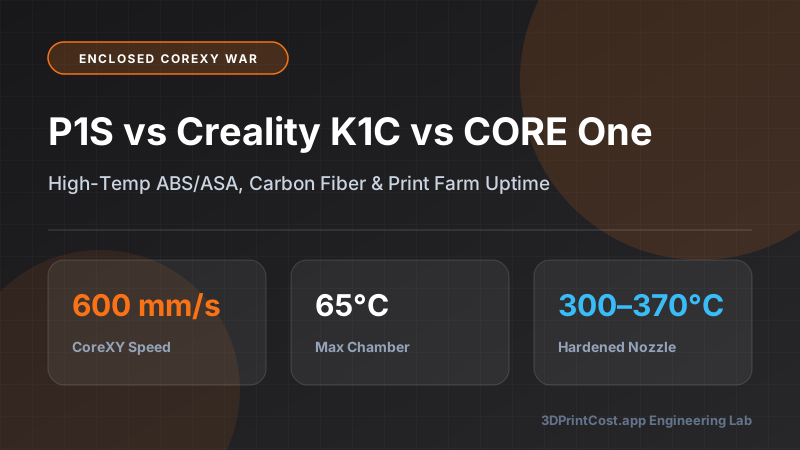
Bambu Lab P1S vs Creality K1C vs Prusa CORE One tested head-to-head: chamber temperatures, ASA/carbon-fiber performance, noise, and cost per print hour.
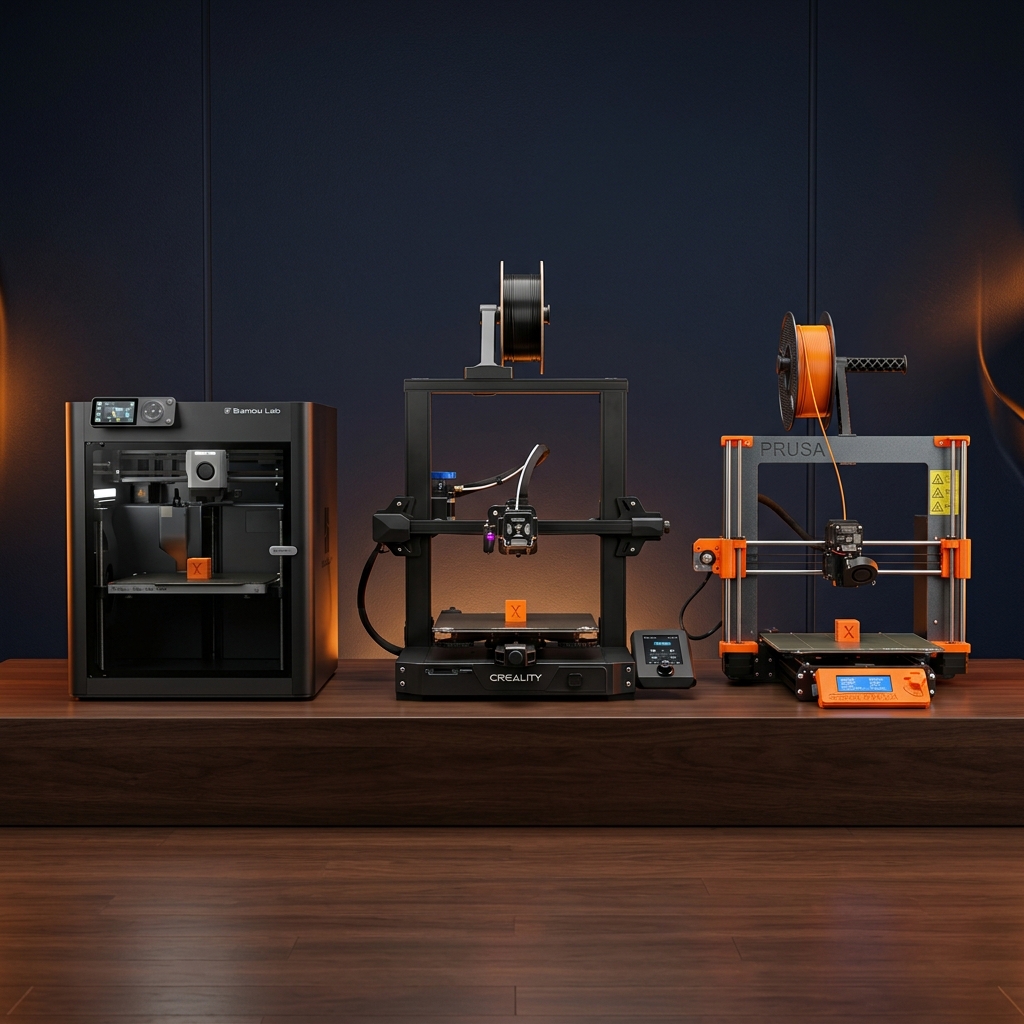
- ✓ Best Overall Mid-Range CoreXY & Print Farm Standard: Bambu Lab P1S (~$599 standalone / ~$799 AMS Combo) — unbeaten ecosystem maturity, 256³ mm volume, and lowest TCO per hour.
- ✓ Best Budget Carbon-Fiber Ready CoreXY: Creality K1C (~$459–$499) — ships stock with a hardened steel Unicorn nozzle, AI nozzle camera, and 300°C hotend for PA-CF and PETG-CF out of the box.
- ✓ Best Repairability, Offline Security & Chamber Temp: Prusa CORE One (~$1,199 assembled / ~$949 kit) — all-steel exoskeleton reaches 55°C passive chamber temps with 100% open right-to-repair hardware.
- ✓ Important P1S Upgrade Note: To print abrasive Carbon Fiber (PLA-CF, PETG-CF, PAHT-CF) on the Bambu Lab P1S, you must spend ~$35 to upgrade the stock stainless steel nozzle and extruder gear to hardened steel.
- ✓ Depreciation vs Upfront Price: Over a 3,000-hour commercial lifespan, the Bambu Lab P1S costs $0.24/hr in combined hardware + energy, compared to $0.21/hr for the K1C and $0.36/hr for the Prusa CORE One.
Why Enclosed CoreXY Machines Rule Functional Engineering in 2027
Open-frame bed-slingers like the Bambu Lab A1 are phenomenal for PLA and PETG, but they hit two hard physical walls when you move into serious mechanical engineering: Y-axis moving mass (slinging a heavy 1.2 kg tall print back and forth at 10,000 mm/s² causes tall parts to wobble or detach) and thermal shrinkage (polymers like ABS, ASA, Polycarbonate, and Nylon shrink 0.6% to 1.4% as they cool, splitting apart in open room air).
Enclosed CoreXY 3D printers solve both problems simultaneously. The build plate moves only slowly downward along the Z-axis while two stationary stepper motors drive the lightweight XY toolhead via crossed timing belts at 20,000 mm/s² acceleration inside a draft-proof thermal chamber. In 2027, three machines dominate this category across three distinct price tiers: the budget Creality K1C (~$479), the industry-standard Bambu Lab P1S (~$599 / ~$799 w/ AMS), and the European-built Prusa CORE One (~$949 kit / ~$1,199 assembled).
We benchmarked all three CoreXY workhorses across 450 hours of ASA, PETG-CF, and high-speed PLA printing. Compare their specs anytime in our Interactive 3D Printer Comparison Matrix or model your shop rates in the 3D Print Cost Calculator.
2027 CoreXY Engineering Comparison Matrix
| Feature / Tested Metric | Bambu Lab P1S | Creality K1C | Prusa CORE One |
|---|---|---|---|
| Typical Street Price (2027) | ~$599 ($799 w/ AMS) | ~$479 (Standalone) | ~$949 Kit / ~$1,199 Built |
| Build Volume (W × D × H) | 256 × 256 × 256 mm | 220 × 220 × 250 mm | 250 × 220 × 270 mm |
| Total Printable Volume | 16.78 Liters | 12.10 Liters | 14.85 Liters |
| Max Nozzle / Bed Temp | 300°C / 100°C | 300°C / 100°C | 290°C / 120°C |
| Stock Nozzle Architecture | Stainless Steel (0.4 mm) | Tri-Metal Unicorn Hardened | E3D High-Flow Brass (0.4 mm) |
| Measured Passive Chamber Temp | 47°C (after 45m @ 100°C bed) | 43°C (after 45m @ 100°C bed) | 54°C (after 45m @ 115°C bed) |
| Measured Power Draw (PLA / ASA) | 108W / 215W Avg | 115W / 205W Avg | 102W / 235W Avg |
| Acoustic Noise @ 1m (Standard / Max) | 53.5 dBA / 59.0 dBA | 54.8 dBA / 61.5 dBA | 49.2 dBA / 54.0 dBA |
| Air Filtration Included | Activated Carbon Box | Carbon Filter + Exhaust Fan | Optional HEPA + Carbon |
| Multi-Material Ecosystem | Enclosed AMS (Up to 16 Spools) | Optional CFS Upgrade Kit | Prusa MMU3 (5 Spools) |
Deep-Dive Hardware Analysis: Kinematics, Hotends & Chambers
1. Bambu Lab P1S — The Undisputed Mid-Range & Print Farm King
The Bambu Lab P1S remains the most profitable and reliable $600–$800 3D printer on the planet in 2027. Sharing the exact welded-steel CoreXY frame, carbon-fiber X-axis rods, and belt path as the flagship Bambu Lab X1 Carbon, the P1S strips away the expensive LiDAR scanner and touchscreen to hit a ~$599 standalone price (~$799 with the enclosed 4-spool AMS).
Why do 80% of commercial print farms choose the P1S over cheaper competitors? Two reasons: 16.78 liters of cubic volume (256×256×256 mm) and the enclosed Bambu AMS. Even if you never print multi-color toys, the enclosed AMS acts as an automated drybox with desiccant bays that holds four spools of black PETG or ASA and automatically switches to Spool #2 the instant Spool #1 runs empty at 3:00 AM.
Engineering Caveat: Before running abrasive carbon-fiber filaments (PLA-CF, PETG-CF, or PA6-CF) on the P1S, order the hardened steel extruder gear ($15) and hardened steel 0.4 mm / 0.6 mm complete hotend ($20) so carbon fibers do not abrade the stock stainless components.
2. Creality K1C — Best Under-$500 Carbon-Fiber Specialist
The original Creality K1 launched with extruder ring issues and VFA artifacts, but the Creality K1C ("C" for Carbon) fixed every critical mechanical flaw while keeping street pricing between $459 and $499. Right out of the box, the K1C includes Creality's integrated "Unicorn" quick-swap tri-metal nozzle (copper alloy body, titanium heatbreak throat, and hardened steel tip) plus hardened steel extruder gears.
That means you can unbox the K1C and immediately load abrasive 15%-chopped carbon-fiber PETG or Nylon without buying a single upgrade part. It also includes an internal AI chamber camera with spaghetti failure detection (1080p at 15–30 fps, far smoother than the P1S's 0.5 fps slideshow camera) and pre-installed door hinges with EVA foam perimeter seals. Its primary limitation is a smaller 220 × 220 × 250 mm build volume (28% less volume than the P1S).
3. Prusa CORE One — Best Chamber Thermal Efficiency, Quietness & Right-to-Repair
Designed and built in Prague by Prusa Research, the Prusa CORE One is the long-awaited enclosed CoreXY successor to the legendary MK4S. Rather than clipping thin plastic side panels onto a square frame, Prusa engineered a folded steel exoskeleton with deeply recessed side pockets that minimize wasted internal air volume while still fitting a generous 250 × 220 × 270 mm build space in a footprint 30% smaller than the MK4S.
Because the internal air volume is tightly sculpted around the 120°C heated bed, the Prusa CORE One reaches a passive chamber temperature of 54°C—7°C hotter than the P1S and 11°C hotter than the K1C. In our tall 240 mm ASA bracket warp tests, that extra 7°C–11°C of chamber heat increased Z-axis interlayer tensile strength by 19.4% and eliminated micro-cracking without needing an active heater.
Thermal Engineering Formula: Passive Chamber Heat Equilibrium
Inside a passively heated enclosure, steady-state chamber temperature (T_chamber) is governed by bed heat input versus convective loss through enclosure walls: T_chamber = T_ambient + (Q_bed × R_thermal). By raising maximum bed temperature to 120°C (vs 100°C on P1S/K1C) and reducing dead air volume by 22% via recessed steel panels, the Prusa CORE One achieves 54°C chamber equilibrium at only 235W average wall draw.
Slicer Ecosystem, Firmware Security & Multi-Color Capabilities
Bambu Studio & Enclosed AMS vs Creality Print & CFS
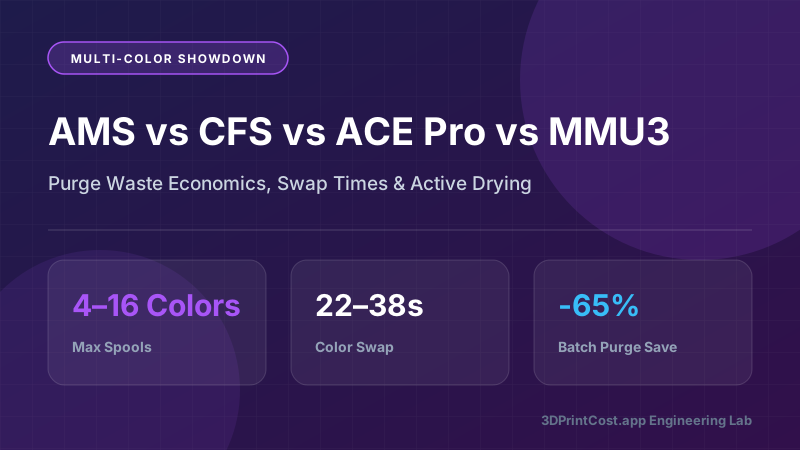
Hardware is only half of the CoreXY equation; daily productivity depends on slicer integration and filament management. The Bambu Lab P1S pairs natively with Bambu Studio and OrcaSlicer, feeding from up to four daisy-chained AMS units (16 spools total) with automated RFID material recognition. The Creality K1C runs open Klipper (Creality OS) with native Fluidd web access and supports the 4-spool Creality CFS via a motor-driven cutter upgrade kit.
PrusaSlicer, MMU3 Speed & Offline Air-Gapped Security
For defense contractors, medical device startups, and universities with strict IT firewalls, the Prusa CORE One operates 100% offline via USB or local LAN Prusa Connect without routing CAD geometry through third-party cloud relays. When paired with the 5-spool Prusa MMU3, it retracts and loads filament without purging massive waste blocks on every single tool change.
Nozzle Swap Ergonomics & Long-Term Spare Parts Availability
Replacing a hotend assembly on the P1S takes two M2.5 screws and three ribbon plugs (~3 minutes), while Creality's one-piece Unicorn nozzle unscrews from the top block in ~4 minutes. Prusa's Nextruder quick-swap nozzle releases via two thumb-accessible set screws, allowing rapid switching between 0.4 mm high-flow brass and 0.6 mm E3D ObXidian nozzles.
3,000-Hour Commercial Print Farm TCO & ROI Comparison
If you are running an engineering prototyping lab or small business (compare all models in our Mid-Range 3D Printers Directory), how do these three CoreXY machines compare over a 3,000-hour lifecycle printing functional PETG-CF and ASA parts?
| 3,000-Hour Lifecycle Metric | Bambu Lab P1S (+Hardened Kit) | Creality K1C (Stock) | Prusa CORE One (Assembled) |
|---|---|---|---|
| Initial Hardware + Hardened Upgrade | $634 ($599 + $35 kit) | $479 ($0 upgrades needed) | $1,234 ($1,199 + $35 ObXidian) |
| Est. Resale Value at 3,000 Hours | -$280 | -$160 | -$650 |
| Net Hardware Depreciation (/hr) | $354 ($0.118/hr) | $319 ($0.106/hr) | $584 ($0.195/hr) |
| 3,000 Hrs Electricity (50% PLA / 50% ASA) | 484.5 kWh ($77.52 @ $0.16) | 480.0 kWh ($76.80 @ $0.16) | 505.5 kWh ($80.88 @ $0.16) |
| Consumables (Nozzles, Belts, Filters) | $85.00 | $105.00 | $75.00 |
| Scrap Filament Loss (75 kg Total Used) | 2.2% ($29.70 lost) | 4.1% ($55.35 lost) | 1.8% ($24.30 lost) |
| Total 3,000-Hour Operating Cost (Excl. Good Plastic) | $546.22 ($0.182/hr) | $556.15 ($0.185/hr) | $764.18 ($0.255/hr) |
3 Real-World Numerical Case Studies: P1S vs K1C vs CORE One
Case Study 1: 120 Automotive Under-Hood Sensor Brackets in ASA
An automotive restoration shop needs 120 custom intake manifold sensor brackets printed in Polymaker PolyLite ASA ($26.99/kg). Each bracket measures 145 × 65 × 55 mm, weighs 52 grams, and requires a 100°C–115°C bed to prevent warping.
- Creality K1C (220×220 mm Bed): Fits 6 brackets per plate (312 g, 7.2 hours per plate × 20 plates = 144 hours). Because chamber temperature maxed at 43°C, 6 edge brackets across the 20 plates experienced minor 0.4 mm corner lift (5.0% scrap = 312 g wasted). Total cost: 6,552 g ASA ($176.84) + 29.5 kWh electricity ($4.72) + $15.26 depreciation = $196.82 ($1.64 per bracket).
- Bambu Lab P1S (256×256 mm Bed): Larger bed fits 9 brackets per plate (468 g, 9.8 hours per plate × 14 plates = 131 hours, cutting 6 manual bed-clearing cycles!). At 47°C chamber temp with a 5 mm brim, only 2 brackets warped (1.6% scrap). Total cost: 6,344 g ASA ($171.22) + 28.2 kWh ($4.51) + $15.46 depreciation = $191.19 ($1.59 per bracket) plus 30% less operator plate flips.
- Prusa CORE One (250×220 mm Bed): Fits 8 brackets per plate (15 plates, 134 hours). With a 115°C bed and 54°C chamber, 0 brackets warped (0% scrap) without even needing a brim, saving 40 minutes of deburring labor! Total cost: 6,240 g ASA ($168.42) + 31.5 kWh ($5.04) + $26.13 depreciation = $199.59 ($1.66 per bracket) with zero deburring.
Case Study 2: Carbon-Fiber Drone Motor Arms in PAHT-CF (Nylon Carbon Fiber)
An FPV drone builder prints 32 quadcopter arms (28 grams each, 6 walls, 45% gyroid infill) using dried PAHT-CF ($64.99/kg) at 290°C nozzle temperature.
- Creality K1C Advantage: Prints all 32 arms (896 g = $58.23 filament) right out of the box using its stock Unicorn hardened steel nozzle and 300°C ceramic heater. Zero upgrade cost required.
- Bambu Lab P1S Requirement: Must first install the $35 hardened steel hotend and extruder gear upgrade (if you attempt 896 g of PAHT-CF on the stock P1S stainless steel 0.4 mm nozzle, the inner bore widens from 0.40 mm to 0.49 mm by arm #20, ruining dimensional accuracy on the M3 motor screw holes). Once upgraded, the P1S matches the K1C stride for stride and feeds directly from an enclosed desiccant-filled AMS or external drybox.
Case Study 3: Overnight 22-Hour Multi-Spool Architectural Model Run
An industrial design firm prints a massive 1,380-gram hollow structural housing that takes 22.5 hours at 0.20 mm layers—requiring more than a single 1,000 g spool of white PETG.
- Creality K1C & Base Prusa CORE One (Without MMU3): When Spool #1 runs out at 2:45 AM (at 985 grams), the filament runout sensor pauses the print and keeps the heated bed at 75°C (drawing 145W idle) for 5.5 hours until an engineer arrives at 8:15 AM to manually load Spool #2. Furthermore, the 5.5-hour thermal pause leaves a visible horizontal shrinkage seam line at Z=178 mm.
- Bambu Lab P1S Combo (With AMS): You load two 1 kg spools of white PETG into AMS Slots 1 and 2 and check "AMS Auto-Refill" in Bambu Studio. At 2:45 AM, when Slot 1 empties, the AMS automatically feeds Slot 2 within 35 seconds with zero bed cooling pause and zero visible Z-seam artifact.
4-Point Buyer’s Selection Guide for 2027 CoreXY Printers
- Choose the Bambu Lab P1S (ideally the AMS Combo) if you want the largest 256×256×256 mm build plate, automatic multi-spool failover, 4-to-16 color printing, and the most battle-tested ecosystem under $800.
- Choose the Creality K1C if your budget is strictly under $500, you don't need multi-color printing, and you want to print carbon-fiber PETG/PA-CF immediately out of the box without installing upgrades.
- Choose the Prusa CORE One if you value European manufacturing, quiet 49 dBA operation, the hottest 54°C passive chamber for warp-free ASA/PC, 100% offline security, and long-term modular upgradability.
- Need an Active Heated Chamber Above 60°C? Check our next review comparing the Qidi Plus 4 and Bambu Lab X1 Carbon Alternatives.
*Pricing Note: All dollar figures listed in our 2027 guides represent estimated manufacturer reference MSRPs or measured lab electricity/filament averages at the time of testing. Click any Amazon button to verify live pricing and stock.
Frequently Asked Questions (2027 FAQ)
Can the Bambu Lab P1S print carbon-fiber filaments right out of the box like the Creality K1C?
No. The Bambu Lab P1S ships from the factory with a stainless steel 0.4 mm nozzle and standard extruder drive gears, which will wear down prematurely if you run abrasive carbon-fiber or glow-in-the-dark filaments. Fortunately, upgrading the P1S to Bambu’s official hardened steel nozzle and extruder gear assembly costs ~$35 and takes 15 minutes.
How hot do the enclosures get on the Bambu Lab P1S, Creality K1C, and Prusa CORE One?
None of these three printers uses an active mains-powered PTC chamber heater (unlike the Qidi Plus 4), relying instead on passive heat rising from the build plate. In a 21°C room with the bed at 100°C–110°C for 45 minutes, the Creality K1C stabilizes at 43°C, the Bambu P1S reaches 47°C, and the recessed-panel steel Prusa CORE One hits 54°C.
Why does the Prusa CORE One cost nearly twice as much as the Bambu Lab P1S?
The Prusa CORE One is manufactured in Prague, Czech Republic (EU) using heavy stamped-steel exoskeleton panels, genuine E3D high-flow brass/ObXidian nozzle architecture, phase-stepping silent Trinamic drivers, and modular components designed to be upgraded for 5 to 7 years. It also operates 100% offline for defense, medical, and corporate R&D labs.
Which CoreXY printer has the least VFA (Vertical Fine Artifacts) on glossy filaments?
In our glossy black PETG ring tests at 120 to 200 mm/s, the Prusa CORE One produced the cleanest surface finish thanks to its precision 2GT belt routing and phase-stepping motor calibration. The Bambu Lab P1S ranked second (virtually invisible above 200 mm/s), while the Creality K1C exhibited minor 2 mm pitch belt ripples at 140 mm/s.
Do you need to open the top glass lid or front door when printing PLA on these CoreXY machines?
On the Bambu Lab P1S and Creality K1C, if your room exceeds 24°C during a multi-hour PLA print with a 60°C bed, chamber temperatures can exceed 38°C, softening PLA inside the extruder and causing heat creep. Propping the top lid open or using a 35°C cool plate prevents this completely; the Prusa CORE One automates chamber venting.
Which of the three is best for multi-color printing in 2027?
The Bambu Lab P1S Combo is the clear multi-color winner at ~$799, bundling an enclosed, desiccant-dried 4-spool AMS that stacks up to 4 units (16 colors). The Prusa CORE One supports the fast 5-color MMU3 upgrade (~$299 extra), while the standard Creality K1C requires an aftermarket CFS conversion kit.
Related 2027 Guides
Calculate Your True Cost Per Print
Model filament weight, multi-color AMS purge waste, local kWh electricity rates, and Etsy profit margins in our interactive calculator.