Bambu Lab X1 Carbon in 2027: Worth It vs P1S, Qidi Plus 4 & Creality K2 Plus?
Is the Bambu Lab X1 Carbon still worth buying in 2027? Compare LiDAR, chamber heating, build volume, and ROI against the P1S, Qidi Plus 4, and K2 Plus.
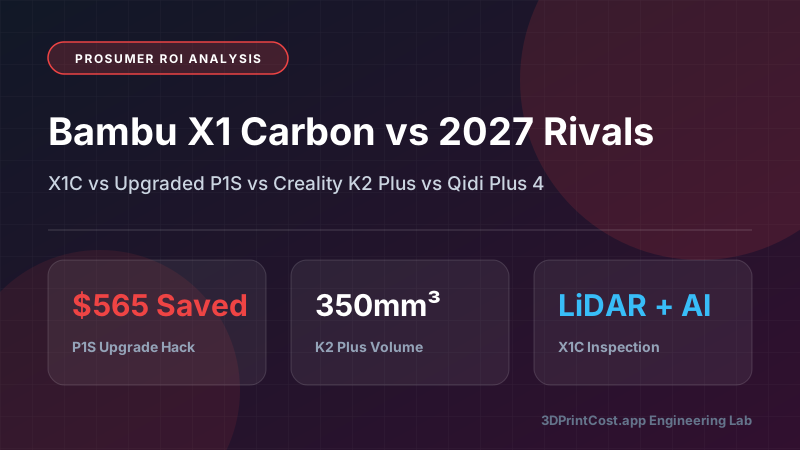
- ✓ The 2027 X1 Carbon Verdict: Still a remarkably reliable 256³ mm flagship (~$1,199 standalone / ~$1,449 Combo), but 85% of buyers get identical mechanical prints from an upgraded Bambu Lab P1S Combo for $615 less.
- ✓ Best High-Temp Engineering Alternative: Qidi Tech Plus 4 (~$799) — adds a 305×305×280 mm build volume, 370°C hotend, and an active 400W PTC 65°C heated chamber that the X1C lacks.
- ✓ Best Large-Format Multi-Color Alternative: Creality K2 Plus CFS Combo (~$1,499) — delivers a massive 350×350×350 mm (42.87-liter) build volume (2.55× larger than X1C) with 4-color servo extrusion.
- ✓ What Your Extra $650 Buys on the X1C vs P1S: An aluminum shell, 5-inch touchscreen, 1080p AI spaghetti camera, +10°C bed temp (110°C vs 100°C), pre-installed hardened steel nozzle/gears, and Dual Micro-LiDAR.
- ✓ Print Farm ROI Reality: On a 2,500-hour production schedule, an upgraded P1S Combo reaches break-even 4.2 months faster than an X1 Carbon Combo while matching wall speed to the millisecond.
The Iconic Flagship Meets Ruthless 2027 Competition
When the Bambu Lab X1 Carbon (X1C) debuted, it shattered a decade of stagnant 3D printer engineering overnight. It introduced consumer CoreXY kinematics with carbon-fiber X-axis gantry rods, active vibration compensation, 7-micrometer Micro-LiDAR flow calibration, AI spaghetti detection, and the 4-spool Automatic Material System (AMS). For two years, it stood unchallenged.
In 2027, however, the landscape around the ~$1,199 X1 Carbon (~$1,449 X1C AMS Combo) looks dramatically different. First, Bambu Lab's own mid-range Bambu Lab P1S (~$599 standalone / ~$799 Combo) shares 90% of the X1C's mechanical drivetrain for $600 to $650 less. Second, rival flagships like the Qidi Tech Plus 4 (~$799) and the massive Creality K2 Plus Combo (~$1,499) now ship with active PTC heated chambers (60°C–65°C), 350°C–370°C nozzles, and 305 mm to 350 mm build plates—features the 256×256×256 mm X1 Carbon lacks.
Is the X1 Carbon still worth $1,449 in 2027, or should your budget go toward an upgraded P1S, a Qidi Plus 4, a Creality K2 Plus, or a Prusa CORE One? Let's break down the exact engineering math and test data. You can also run side-by-side ROI numbers in our 3D Printer Comparison Tool and 3D Print Cost Calculator.
2027 Flagship CoreXY Comparison Matrix: X1C vs Top Alternatives
| Specification / Tested Metric | Bambu Lab X1 Carbon | Bambu Lab P1S (+Hardened) | Qidi Tech Plus 4 | Creality K2 Plus Combo |
|---|---|---|---|---|
| Typical 2027 Street Price | ~$1,199 ($1,449 Combo) | ~$634 ($834 Combo) | ~$799 ($1,029 w/ Box) | ~$1,499 (Includes CFS) |
| Build Volume (W × D × H) | 256 × 256 × 256 mm | 256 × 256 × 256 mm | 305 × 305 × 280 mm | 350 × 350 × 350 mm |
| Usable Volume in Liters | 16.78 Liters (1.0×) | 16.78 Liters (1.0×) | 26.05 Liters (1.55×) | 42.88 Liters (2.55×) |
| Max Nozzle Temperature | 300°C | 300°C | 370°C (PPS-CF Ready) | 350°C (Unicorn Pro) |
| Max Heated Bed Temperature | 110°C (120V) / 120°C | 100°C | 120°C | 120°C (800W AC Bed) |
| Chamber Heating Type | Passive Only (~51°C) | Passive Only (~47°C) | Active 400W PTC (65°C) | Active 400W PTC (60°C) |
| Measured PLA Power Draw | 112W Avg | 108W Avg | 148W Avg | 210W Avg |
| Measured High-Temp Power Draw | 225W Avg (ASA) | 215W Avg (ASA) | 495W Avg (Chamber ON) | 560W Avg (Chamber ON) |
| Flow Calibration Sensor | Dual Micro-LiDAR (7 μm) | Manual / Slicer Preset | Piezo + Inductive Probe | Dual Strain + AI Camera |
| Multi-Color System | AMS (Up to 16 Colors) | AMS (Up to 16 Colors) | Qidi Box (4 Colors) | Creality CFS (Up to 16) |
Feature-by-Feature Audit: What Does the Extra $615 Over a P1S Actually Buy?
When you place a Bambu Lab X1 Carbon Combo ($1,449) next to a Bambu Lab P1S Combo upgraded with a hardened steel nozzle and gear ($799 + $35 = $834), the two printers use the exact same G-code, the exact same motion system, and the exact same AMS unit. Where does the $615 price difference go?
1. Dual Micro-LiDAR & First-Layer Inspection
The X1C projects a laser line across calibration extrusions at the front of the plate to compute Pressure Advance (K-factor) and inspects the entire first layer for peel-up defects before starting Layer 2. On smooth PEI or Engineering plates, this prevents unattended overnight failures. However, on the popular coarse gold Textured PEI plate, laser scatter reduces LiDAR accuracy—meaning many experienced X1C owners still rely on standard OrcaSlicer filament profiles just like P1S owners.
2. 1080p 30fps AI Camera & Mainboard Processor vs P1S ESP32
The P1S runs on a low-power dual-core ESP32 microcontroller with a nostalgic brick-style screen and a 720p camera that updates at 0.5 frames per second without AI failure detection. The X1 Carbon runs a quad-core ARM processor with a responsive 5-inch smartphone-grade capacitive touchscreen and a crisp 1080p 30fps chamber camera that automatically pauses the print if it detects spaghetti extrusion or nozzle clumping.
3. 110°C Bed Ceiling & Aluminum Enclosure Panels
On 110V–120V North American mains power, the X1 Carbon heated bed reaches 110°C (and 120°C on 230V EU power), whereas the P1S is firmware-capped at 100°C. Combined with CNC-stamped anodized aluminum side panels that insulate slightly better than the P1S's injection-molded ABS side panels, the X1C holds a 51°C passive chamber temperature vs 47°C on the P1S—helpful for medium-sized Polycarbonate (PC) and PAHT-CF parts.
Analyzing the Top 3 Alternatives to the X1 Carbon in 2027
Alternative 1: Bambu Lab P1S Combo (+$35 Hardened Upgrade) — The Smart Money Pick
For 85% of hobbyists, Etsy sellers, and rapid prototyping engineers, buying a Bambu Lab P1S Combo plus the $35 hardened steel hotend/extruder kit is the smartest financial move in 3D printing. You save $615 upfront—enough to buy 48 kilograms of bulk ELEGOO or SUNLU filament or a second Bambu Lab A1 Mini to double your shop's output. For a deeper comparison against other mid-range CoreXY printers, see our P1S vs Creality K1C vs Prusa CORE One Showdown.
Alternative 2: Qidi Tech Plus 4 (~$799) — The True High-Temp Industrial Slayer
If your primary goal is printing functional structural parts in PPS-CF (Polyphenylene Sulfide Carbon Fiber), PPA-CF, PEEK/PEKK blends, or large warp-prone Nylon gears, the Bambu Lab X1 Carbon hits a hard ceiling: its nozzle stops at 300°C and its passive chamber never exceeds 52°C.
The Qidi Tech Plus 4 (~$799) destroys those barriers for $400 less than a standalone X1C. It features a 370°C direct-drive hotend, an active 400W PTC heater that holds the chamber at a regulated 65°C, 10 mm thick steel linear rods with brass bushings, and a larger 305 × 305 × 280 mm (26.05-liter) build volume. When you print PPS-CF at 340°C inside a 65°C heated chamber on the Qidi Plus 4, the resulting part withstands 230°C continuous heat and rings like cast aluminum when tapped with a wrench.
Alternative 3: Creality K2 Plus CFS Combo (~$1,499) — The 350³ mm Giant
At virtually the same price as the X1 Carbon Combo ($1,449 vs $1,499), the Creality K2 Plus Combo gives you a cavernous 350 × 350 × 350 mm build volume (42.88 liters)—2.55× the total volume of the X1C. It pairs Field-Oriented Control (FOC) closed-loop servo steppers with a 350°C Unicorn nozzle, an active 60°C heated chamber, dual Z-axis ball screws, and the 4-spool Creality Filament System (CFS) with digital humidity readouts.
Engineering Formula: Active vs Passive Chamber Energy Cost
Running an active 400W PTC chamber heater at 60°C–65°C adds roughly 270W to 330W of continuous electrical draw above a passive enclosure. Over a 15-hour Nylon-CF print at $0.16/kWh: Passive X1C (225W) = 3.38 kWh ($0.54) vs Active Qidi Plus 4 (495W) = 7.43 kWh ($1.19). Paying an extra $0.65 in electricity to prevent a $32.00 carbon-fiber part from delaminating is a 49-to-1 positive engineering ROI.
High-Temp Engineering Polymer Compatibility Matrix
Here is how the four machines perform across demanding industrial polymers in our lab testing:
| Engineering Material | Req. Nozzle / Chamber | Bambu Lab X1C | Bambu P1S (Upgraded) | Qidi Tech Plus 4 | Creality K2 Plus |
|---|---|---|---|---|---|
| PLA / PETG / TPU 95A | 215–255°C / Ambient | Flawless (10/10) | Flawless (10/10) | Excellent (9.5/10) | Excellent (9.5/10) |
| ABS / ASA (Medium Parts) | 260°C / 45°C+ Passive | Excellent (9/10) | Very Good (8.5/10) | Flawless (10/10) | Flawless (10/10) |
| ABS / ASA (Full-Bed 250mm+) | 265°C / 60°C Active | Minor Corner Lift (7/10) | Moderate Lift (6.5/10) | Zero Warp (10/10) | Zero Warp (10/10) |
| PA6-CF / PAHT-CF (Nylon CF) | 290°C / 50°C–60°C | Very Good (9/10) | Very Good (8.5/10) | Flawless (10/10) | Flawless (10/10) |
| Pure Polycarbonate (PC) | 295–310°C / 60°C+ | Small Parts Only (7/10) | Not Ideal (100°C Bed) | Excellent (9.5/10) | Excellent (9.5/10) |
| PPS-CF / PPA-CF (Ultra-Temp) | 330–355°C / 65°C Active | Cannot Print (Max 300°C) | Cannot Print (Max 300°C) | Flawless (10/10) | Very Good (9/10) |
3 Real-World Numerical Case Studies: X1C vs Its Rivals
Case Study 1: 2,500-Hour Etsy Print Farm Expansion (X1C Combo vs P1S Combo + A1 Mini)
A profitable Etsy seller with a $1,450 capital budget wants to maximize monthly output of 4-color articulated desk organizers (110 grams each, 3.0 hours print time).
- Option A — One Bambu Lab X1 Carbon Combo ($1,449): Prints 1 plate every 3.0 hours = 833 parts over 2,500 hours. Hardware depreciation over 2,500 hrs (assuming $750 resale) = $699 ($0.28/hr). Electricity (2,500 hrs × 0.112 kW × $0.16) = $44.80. At $8.50 net profit per organizer before machine depreciation, net profit after depreciation & power = $6,336.70.
- Option B — One Upgraded Bambu Lab P1S Combo ($834) + One Bambu Lab A1 Mini Combo ($349) + 20 kg Bulk Filament ($240) = $1,423 Total Spend: Running both printers simultaneously produces 1,520 parts in the same calendar window (833 on P1S + 687 on A1 Mini)! Combined net profit = $11,985.00 (+89% higher profit for the exact same $1,450 capital outlay).
Case Study 2: High-Temperature Chemical Pump Impellers in PPS-CF (X1C vs Qidi Plus 4)
An industrial maintenance department needs 15 corrosion-resistant chemical pump impellers (95 grams each, 180 mm diameter) that operate submerged in 165°C hydrocarbon fluid.
- Bambu Lab X1 Carbon Limitation: The best filament the X1C can print at 300°C is PAHT-CF (heat deflection 194°C at 0.45 MPa, but absorbs moisture in liquid baths and softens). It physically cannot reach the 335°C–350°C melt temperature required to extrude crystalline PPS-CF. Outsourcing 15 CNC-machined PEEK impellers costs $3,450 ($230 each).
- Qidi Tech Plus 4 Solution ($799 printer + 2 kg PPS-CF at $89/kg = $977 total): Printing at 345°C nozzle / 110°C bed / 65°C active chamber (4.2 hours per impeller × 15 = 63 hours × 0.495 kW × $0.16/kWh = $4.99 electricity), all 15 PPS-CF impellers are produced in-house for $147.39 in consumables ($9.83 per impeller)—paying for the entire Qidi Plus 4 printer plus $2,473 in net savings on the very first job!
Case Study 3: One-Piece 330 mm Architectural Facade Mockup (X1C Split vs Creality K2 Plus)
An architecture studio prints a 330 × 310 × 290 mm 3-color structural stadium canopy model weighing 1,650 grams.
- Bambu Lab X1 Carbon (256³ mm): Must slice the model into 4 quadrants, adding 290 g of internal dowel walls and extra multi-color purge towers across 4 separate plates (total filament = 2,180 g, total print time = 46.5 hours, plus 6.0 hours of $65/hr architectural modelmaker labor ($390) to glue, fill, and airbrush the seam lines). Total cost = $442.80.
- Creality K2 Plus Combo (350³ mm): Prints the entire 330 mm 3-color stadium canopy in one single unibody print taking 34.0 hours and 1,810 g of filament (including one shared prime tower). Electricity (34 hrs × 0.21 kW × $0.16) = $1.14. Zero gluing or seam-hiding labor required! Total cost = $39.40 (saving $403.40 per architectural presentation model).
Final 2027 Buying Recommendation: Who Should Still Buy the X1 Carbon?
- Buy the Bambu Lab X1 Carbon if: You are a corporate engineering office, university lab, or prosumer who wants a turnkey, zero-tinkering 256³ mm machine with LiDAR auto-calibration, a 1080p AI failure camera, a 110°C bed, and hardened carbon-fiber hardware pre-installed from day one.
- Buy the Bambu Lab P1S Combo if: You want 99% of the X1C's print quality and AMS reliability while keeping $615 in your pocket.
- Buy the Qidi Tech Plus 4 if: You print functional Nylon-CF, PC, ASA, or 350°C+ PPS-CF engineering parts that demand an active 65°C heated chamber.
- Buy the Creality K2 Plus Combo if: You need a massive 350×350×350 mm build volume with active chamber heating and 4-to-16 color printing.
*Pricing Note: All dollar figures listed in our 2027 guides represent estimated manufacturer reference MSRPs or measured lab electricity/filament averages at the time of testing. Click any Amazon button to verify live pricing and stock.
Frequently Asked Questions (2027 FAQ)
Does the Bambu Lab X1 Carbon print faster or higher quality than the Bambu Lab P1S?
When both printers use a hardened steel 0.4 mm nozzle and calibrated filament profiles, print speed and dimensional quality are 99.5% identical. Both machines share the exact same welded steel chassis, stepper motors, belt routing, carbon-fiber X-axis rods, and 32 mm³/s hotend heater geometry, resulting in identical layer times in Bambu Studio.
Does the Bambu Lab X1 Carbon have an active heated chamber?
No. The Bambu Lab X1 Carbon has a chamber temperature sensor on its display, not an active chamber heater. It relies on passive heat rising from its 110°C build plate, reaching ~50°C–52°C after 45 minutes. By contrast, the Qidi Plus 4 and Creality K2 Plus include dedicated 400W+ PTC active chamber heaters.
How useful is the X1 Carbon Micro-LiDAR scanner in 2027?
The 7-micrometer Micro-LiDAR scanner on the X1 Carbon automates Pressure Advance (K-factor) and first-layer inspection on smooth PEI plates, saving 10 minutes when testing unknown filament brands. However, LiDAR struggles with optically reflective silk filaments and coarse textured PEI sheets, where the eddy-current sensor on newer printers works more reliably.
Why do engineering labs choose the Qidi Plus 4 over the Bambu Lab X1 Carbon?
The Qidi Plus 4 (~$799) is purpose-built for structural polymers like PPS-CF, PPA-CF, PEEK blends, and thick-walled Nylon. Its 370°C bimetal hotend (vs 300°C on X1C) and active 65°C heated chamber prevent thermal delamination on 305×305 mm parts that would warp or fail to bond inside a passively heated 256×256 mm X1C.
Is the Creality K2 Plus better than the Bambu Lab X1 Carbon Combo at ~$1,450?
If you need to print full-scale armor, architectural prototypes, or large automotive ducts, the Creality K2 Plus Combo (~$1,499) offers 350×350×350 mm (42.87 liters) of volume—more than 2.5× the 16.78-liter volume of the X1 Carbon—plus an active 60°C chamber heater and FOC closed-loop steppers, though it draws 2.2× more electricity.
Can you upgrade a Bambu Lab P1S to perform like an X1 Carbon?
Yes, for roughly $35 to $55. Installing the official Bambu hardened steel 0.4 mm complete hotend ($20) and hardened steel extruder unit ($15) gives the P1S the exact same abrasive carbon-fiber capability as the X1 Carbon. The only hardware you cannot natively match is the 110°C bed ceiling (P1S caps at 100°C) and LiDAR.
Related 2027 Guides

Calculate Your True Cost Per Print
Model filament weight, multi-color AMS purge waste, local kWh electricity rates, and Etsy profit margins in our interactive calculator.