How Much Does 3D Printing Cost in 2027? Real Cost-Per-Print Breakdown
Calculate the true cost of 3D printing in 2027: printer hardware, filament $/gram, metered electricity, nozzle wear, machine depreciation, and failures.
- ✓ A typical functional 3D print in 2027 costs between $0.024 and $0.042 per gram when accounting for all six cost variables: raw filament, purge/support waste, metered electricity, hardware depreciation, consumable wear, and failure rate.
- ✓ Raw filament ($13.99–$24.99/kg, or $0.014–$0.025/g) accounts for only 55% to 68% of the true cost of a finished part; ignoring machine depreciation and failed prints leads to severe underpricing for Etsy and print-on-demand sellers.
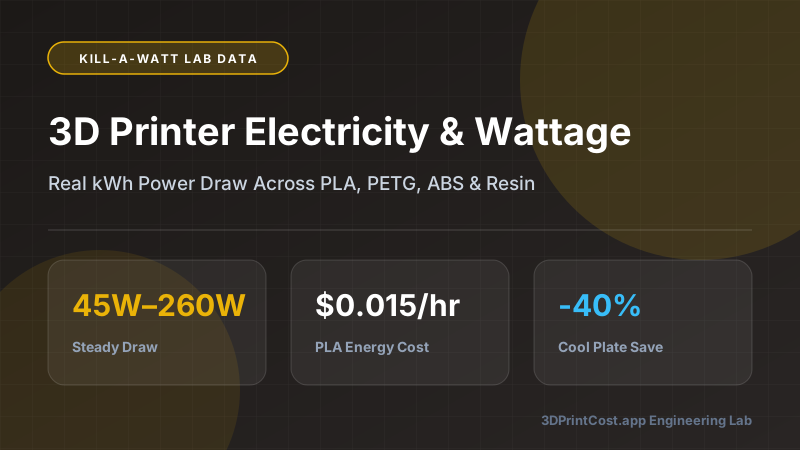
- ✓ Electricity is surprisingly cheap for open-frame PLA printing ($0.010–$0.018 per print hour at $0.16/kWh), but jumps to $0.035–$0.058 per hour when running enclosed high-temperature ABS/ASA chambers with active filament dryers.
- ✓ Single-nozzle multi-color printing (AMS / CFS / ACE Pro) can increase total material cost by 80% to 250% on small single items due to purge waste, making plate batching mandatory for economical multi-color parts.
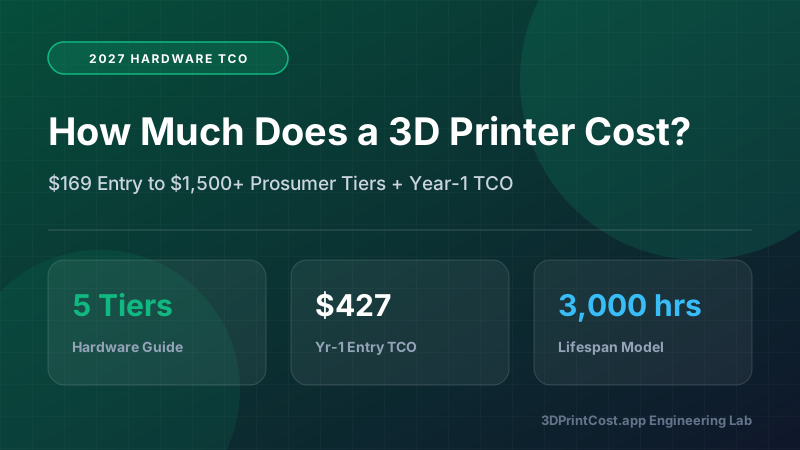
- ✓ Hardware depreciation averages $0.06 to $0.22 per printing hour across a 3,500-hour consumer service life, plus $0.015 to $0.035 per hour for replacement nozzles, PEI build plates, and extruder gears.
Ask ten hobbyists how much it costs to 3D print a replacement headphone bracket or a custom board-game organizer, and nine of them will glance at their slicer preview, see "40 grams of PLA," and tell you it costs 60 cents. While that back-of-the-napkin math feels comforting, it ignores nearly half of the real expenses that leave your bank account over the lifespan of a 3D printer.
Whether you are justifying your first machine purchase, optimizing a multi-printer workshop, or pricing products for an online shop, understanding the true, audited cost per print in 2027 requires tracking six distinct engineering variables: upfront hardware capital, filament spool price and waste overhead, metered AC wall electricity (kWh), hourly mechanical depreciation, consumable maintenance (nozzles, PEI sheets, extruder gears, lubricants), and statistical print failure rates. You can plug your own numbers into our live 3D Print Cost Calculator at any point, or follow our complete engineering breakdown below.
The 6 Cost Pillars of Desktop 3D Printing in 2027
To prevent hidden expenses from ambush-taxing your hobby or business, let's break down every dollar spent from initial unboxing through 3,500 hours of operation.
| Cost Pillar | 2027 Budget Entry Tier | 2027 Mid-Range All-Rounder | 2027 Pro Enclosed CoreXY | MSLA 8K/12K Resin Setup |
|---|---|---|---|---|
| Representative Printer | Bambu Lab A1 Mini / Ender 3 V3 SE | Bambu Lab A1 / Centauri Carbon | Bambu P1S Combo / Prusa CORE One | Elegoo Saturn 4 Ultra + Wash/Cure |
| Upfront Hardware Cost | $169 – $199 | $299 – $359 | $699 – $1,199 | $399 printer + $140 Wash/Cure |
| Day-1 Accessories | $45 (Dryer + cutters) | $65 (Dryer + spare PEI plate) | $95 (4-spool dryer + hardened nozzle) | $85 (IPA, gloves, silicone mats, respirator) |
| Material Cost ($/kg) | $13.99 – $18.99/kg (PLA/PETG) | $14.99 – $22.99/kg (PLA+/PETG/TPU) | $18.99 – $39.99/kg (ASA/PC/PA-CF) | $19.99 – $34.99/kg (8K Standard/Tough) |
| Electricity Cost / Hr (@$0.16/kWh) | $0.009 – $0.016 / hr | $0.015 – $0.022 / hr | $0.024 – $0.042 / hr | $0.011 / hr (UV LED array) |
| Depreciation + Wear / Hr | $0.075 – $0.095 / hr | $0.105 – $0.135 / hr | $0.175 – $0.260 / hr | $0.195 / hr (LCD screen + ACF film wear) |
Pillar 1: Upfront Printer Hardware & Day-One Ecosystem Costs
The sticker price of a 3D printer is lower in 2027 than at any point in history, adjusted for speed and reliability. However, the printer chassis alone is never your final receipt.
1. Open-Frame Bed-Slingers ($169–$339)
Machines in the budget 3D printer tier—led by the $169 Creality Ender 3 V3 SE, $199 Bambu Lab A1 Mini, and $339 Bambu Lab A1—require minimal ancillary hardware. Add a $45 single-spool filament dryer, a $12 deburring and flush-cutter set, and three 1 kg spools of PLA ($45), and you are fully operational for $270 to $440 all-in.
2. Enclosed Multi-Color & Engineering CoreXY ($549–$1,499)
Stepping into the mid-range and professional 3D printer tiers—such as the Bambu Lab P1S Combo ($749 with AMS), Creality K2 Plus, or Qidi Plus 4—introduces multi-spool drying and air filtration requirements. A 4-spool dryer box ($129), spare hardened steel 0.4 mm and 0.6 mm hotends ($35–$60), and activated carbon replacement cartridges ($25) add $180–$220 to the initial invoice.
Pillar 2: Filament Cost Per Gram & The Purge Waste Multiplier
In 2027, buying a single 1 kg spool of basic PLA at $24.99 is unnecessary unless you need a specialty color match. Buying 4-packs of high-speed PLA or Rapid PETG drops raw material costs to $12.50–$15.99 per kilogram ($0.0125–$0.0160 per gram), especially when tracking seasonal promotions on our 3D Printing Deals page.
3. Single-Color Support & Calibration Overhead (4% to 18%)
Even on a single-color print, 1,000 grams on a spool never yields 1,000 grams of finished parts. Every job expends 1.2 g to 2.5 g on the pre-print nozzle purge and dynamic flow calibration lines. Complex overhanging geometries require organic tree supports that add 8% to 22% to part weight. And almost every spool leaves 12 g to 25 g of unusable "end-of-spool" tail unless you feed it into an automated filament runout joiner.
4. Multi-Color AMS / CFS Purge Waste (The "Poop" Tax)
Single-nozzle multi-color systems must cut the active filament, retract it, push the new color into the hotend, and purge 0.25 g to 0.45 g of molten plastic down the chute on every color swap to prevent dark pigments from bleeding into light colors, plus build a hollow prime tower on the bed. If a 60-gram figurine has 380 color changes, it will eject 135 grams of waste—turning a $0.96 print into a $3.12 print! For a deep dive into cutting purge volume by 45%, read our AMS Multi-Color Waste Reduction Guide.
Pillar 3: Metered Electricity Cost (Watts & kWh Audited)
Many articles lazily multiply a printer's power supply rating (e.g., 350W or 1,000W) by print hours. That is physically wrong: a 350W power supply only draws 320W for the first 90 seconds while bringing the heated bed from 21°C room temperature up to 60°C. Once at thermal equilibrium, pulse-width modulation (PWM) cycles the bed heater at 20–30% duty cycle. Check our 3D Printer Electricity Cost Study for full Kill-A-Watt and smart-plug telemetry.
5. Real-World Metered Wattage by Printer & Material
- Bambu Lab A1 Mini (PLA @ 215°C / 60°C bed): 58W average → 0.058 kWh/hr → $0.0093 per hour at $0.16/kWh.
- Bambu Lab A1 / Prusa MK4S (PLA @ 220°C / 60°C bed): 95–98W average → 0.096 kWh/hr → $0.0154 per hour.
- Enclosed CoreXY (PETG @ 245°C / 75°C bed): 138W average → 0.138 kWh/hr → $0.0221 per hour.
- Enclosed CoreXY (ABS/ASA @ 265°C / 105°C bed + 65°C chamber heater + filament dryer): 285W–340W combined average → 0.310 kWh/hr → $0.0496 per hour.
Pillar 4 & 5: Hourly Machine Depreciation, Consumables & Failure Rates
3D printers are electromechanical CNC machines with sliding bearings, toothed GT2 belts, heater cartridges, and high-friction nozzles. Treating machine time as "free" guarantees you won't have the cash set aside when your extruder gear strips or your PEI sheet loses adhesion at hour 1,200.
Hourly Depreciation & Consumable Schedule Formula
Hourly Machine Rate ($/hr) = [(Printer Price − 20% Salvage Value) ÷ 3,500 Lifespan Hours] + [Annual Consumables ($55) ÷ 500 Annual Hours]
6. Consumable Wear Lifespans (2027 Benchmarks)
- Stainless Steel 0.4 mm Nozzle ($12): ~600 hours (PLA/PETG) → $0.020/hr.
- Hardened Steel 0.4 mm Nozzle ($18–$35): ~2,000 hours (even with CF/GF abrasives) → $0.012/hr.
- Textured PEI Spring Steel Build Plate ($22): ~1,200 hours (600hours per side) → $0.018/hr.
- PTFE Bowden Guide Tubes, Silicone Socks & Filament Cutters ($15 kit): ~1,000 hours → $0.015/hr.
7. The Statistical Failure Tax (1.8% to 8.5%)
Even on an automated 2027 printer, prints occasionally fail due to wet filament, poor slicer support placement, power blips, or tall parts getting knocked over by a curled overhang. When a 10-hour print fails at hour 7, you lose 70% of the filament, 7 hours of electricity, and 7 hours of machine wear. Multiplying your subtotal by 1.02 (for Bambu/Prusa PLA workflows) or 1.06 (for budget printers or complex ABS/ASA parts) ensures failed jobs are amortized accurately.
3 Real-World Numerical Case Studies: Exact Cost-Per-Print Math
Let's apply the complete 6-pillar engineering formula to three real prints across three different printer classes at the US average electricity rate of $0.16/kWh.
Case Study 1: 38-Gram Articulated Fidget Octopus (Single-Color Bulk PLA)
A bestseller at craft fairs and school fundraisers, printed on a Bambu Lab A1 Mini ($199) using bulk SUNLU High-Speed PLA bought in a 4-pack at $13.49/kg ($0.0135/g).
- Filament + Purge: 38.0 g model + 1.5 g prime line = 39.5 g × $0.0135/g = $0.533.
- Electricity (1 hr 12 min = 1.20 hrs @ 58W): 1.20 hrs × 0.058 kW × $0.16/kWh = $0.011.
- Machine Depreciation ($199 over 3,500 hrs w/ 20% salvage): 1.20 hrs × $0.045/hr = $0.054.
- Consumable Wear (Nozzle + PEI + Tube): 1.20 hrs × $0.042/hr = $0.050.
- Failure Buffer (1.6% A1 Mini PLA rate): ($0.533 + $0.011 + $0.054 + $0.050) × 1.016 = $0.66 true all-in cost ($0.0174 per gram of finished part).
Case Study 2: 340-Gram Under-Desk Headphone & Controller Clamp (Rapid PETG)
A heavy-duty structural clamp with threaded printed bolts, printed on a Bambu Lab A1 ($339) in Rapid PETG ($16.99/kg or $0.0170/g) with 5 wall loops and 40% gyroid infill.
- Filament + Supports: 318.0 g parts + 22.0 g tree supports/brim = 340.0 g × $0.0170/g = $5.780.
- Electricity (5 hrs 30 min = 5.50 hrs @ 115W + 2 hrs dryer @ 45W): (0.6325 kWh + 0.090 kWh) × $0.16/kWh = $0.116.
- Machine Depreciation ($339 over 3,500 hrs): 5.50 hrs × $0.077/hr = $0.424.
- Consumable Wear: 5.50 hrs × $0.048/hr = $0.264.
- Failure Buffer (2.8% PETG rate): ($5.780 + $0.116 + $0.424 + $0.264) × 1.028 = $6.77 true all-in cost ($0.0213 per gram of finished 318g assembly).
Case Study 3: 620-Gram Full-Scale Cosplay Mandalorian Helmet (PLA+)
A full wearable helmet printed in one piece on a 256×256×256 mm Elegoo Centauri Carbon ($299) using eSUN PLA+ ($18.99/kg or $0.0190/g) with lightning infill and organic dome-perimeter supports.
- Filament + Supports: 495.0 g helmet shell + 125.0 g organic tree supports = 620.0 g × $0.0190/g = $11.780.
- Electricity (14 hrs 15 min = 14.25 hrs @ 112W): 1.596 kWh × $0.16/kWh = $0.255.
- Machine Depreciation ($299 over 3,500 hrs): 14.25 hrs × $0.068/hr = $0.969.
- Consumable Wear: 14.25 hrs × $0.050/hr = $0.713.
- Failure Buffer (4.5% long-print tall-support risk): ($11.780 + $0.255 + $0.969 + $0.713) × 1.045 = $14.33 true all-in cost (compared to $95–$140 for an unpainted resin-cast or commercial replica helmet).
Master Cost-Per-Part Summary Table Across 6 Popular Print Jobs
Here is a quick-reference lookup table comparing raw slicer filament cost against true 6-pillar audited cost across six everyday 3D printing projects.
| Project Type | Material | Finished Weight | Waste / Purge | Print Time | Raw Filament Only | True All-In Cost (6 Pillars) |
|---|---|---|---|---|---|---|
| 3DBenchy Calibration Boat | Bulk PLA ($14/kg) | 13 g | 1.5 g | 0.45 hrs | $0.20 | $0.26 |
| 2×3 Gridfinity Bin | Matte PLA ($16/kg) | 54 g | 1.8 g | 1.40 hrs | $0.89 | $1.08 |
| 4-Color Keychain (Single) | PLA ($18/kg) | 12 g | 38.0 g (AMS) | 1.85 hrs | $0.90 | $1.24 |
| 4-Color Keychain (Batch of 12) | PLA ($18/kg) | 144 g (12g ea) | 41.0 g (Shared) | 7.20 hrs | $0.28 / ea | $0.39 / ea |
| Outdoor Security Cam Mount | ASA ($25/kg) | 115 g | 14.0 g | 3.40 hrs | $3.23 | $4.28 |
| 32mm Tabletop Mini (Resin) | 8K Resin ($24/kg) | 6 g | 3.5 g + IPA | 1.90 hrs | $0.23 | $0.74 |
5 Proven Engineering Tactics to Cut Your 3D Printing Costs by 35%
Once you measure your costs accurately, reducing them becomes an exercise in slicer and workflow optimization. For commercial operators, also consult our How to Price 3D Prints for Sale business playbook.
Cost Optimization Checklist for 2027
- Switch from Grid/Rectilinear to Lightning or Adaptive Cubic Infill: For non-structural decorative models (helmets, busts, terrain), Lightning infill supports only top roofs, cutting internal filament usage by 45% to 65% and print time by 35%.
- Add Perimeters Instead of Increasing Infill Density: Mechanical bending strength comes from outer shell walls (moment of inertia), not core infill. Increasing walls from 2 to 4 at 15% gyroid infill produces a stronger bracket using 22% less plastic than 2 walls at 50% infill.
- Use a 0.6 mm Nozzle for Functional Brackets: A 0.6 mm nozzle extruding 0.30 mm layers with 2 walls matches the wall thickness (1.2 mm) of a 0.4 mm nozzle with 3 walls while cutting print time—and hourly depreciation—by 38%.
- Adopt Low-Temp CryoGrip Build Plates for PLA: Polyurethane cool plates hold PLA rock-solid at a 35°C bed temperature instead of 60°C, slashing printer electricity draw by 40% to 48%.
- Weigh Every Spool With a Digital Gram Scale: Log empty spool tare weights (~140g for cardboard, ~250g for reusable ABS spools) so you never throw away 60-gram leftover remnants that could print three Gridfinity bins.
Ready to run the exact numbers for your own printer, local $/kWh utility rate, and STL weight? Launch our free 3D Print Cost Calculator right now to generate a line-by-line cost breakdown in seconds.
*Pricing Note: All dollar figures listed in our 2027 guides represent estimated manufacturer reference MSRPs or measured lab electricity/filament averages at the time of testing. Click any Amazon button to verify live pricing and stock.
Frequently Asked Questions (2027 FAQ)
How much does a small 3D print like a 3DBenchy or miniature actually cost?
A standard 13-gram 3DBenchy boat printed in bulk High-Speed PLA ($14.99/kg) on a Bambu Lab A1 Mini takes 28 minutes, consumes $0.21 in filament (including 1.2g prime purge), $0.005 in electricity, and $0.045 in machine depreciation and wear—totaling just $0.26 in real all-in cost.
Does a 3D printer increase your home electric bill noticeably?
For casual hobbyists, electricity impact is minor. Running a 95W PLA printer for 40 hours a month consumes 3.8 kWh, adding just $0.61/month at the $0.16/kWh US average. Even a 24/7 commercial print-farm machine running 600 hours/month in PETG (135W) adds only $12.96/month per printer.
Why is slicer filament weight lower than the actual filament used from the spool?
Slicers often under-report total spool consumption unless you include start-of-print flow calibration lines, nozzle prime wipes, skirt/brim loops, tree supports, and multi-color purge towers. Always add a 3% to 5% single-color waste factor—or weigh your finished part plus waste bin on a 0.1g digital scale.
How do you calculate 3D printer depreciation per hour?
Subtract the estimated resale/salvage value (typically 20% of retail) from the purchase price, then divide by the expected lifespan in print hours (3,000 hours for budget printers, 4,500–6,000 hours for CoreXY workhorses). A $339 Bambu Lab A1 depreciates at roughly ($339 - $68) ÷ 3,500 = $0.077 per hour.
Is resin 3D printing more expensive per gram than FDM filament printing?
Yes, MSLA resin printing costs roughly 2.2× to 3.0× more per gram than FDM printing. While standard photopolymer resin costs $19–$28/kg, you must also buy 99% Isopropyl Alcohol ($18/gallon), nitrile gloves, paper towels, and replace LCD masking screens ($85–$130 every 1,500 hours) and FEP/ACF release films.
How much should I charge customers for 3D printed parts?
Never price parts by multiplying raw filament cost by 2× or 3×. Calculate your true landed manufacturing cost (filament + waste + electricity + depreciation + consumables + failure buffer + post-processing labor at $20–$30/hr), then apply a 2.5× wholesale or 4.0× direct-to-consumer retail margin.
Related 2027 Guides
Calculate Your True Cost Per Print
Model filament weight, multi-color AMS purge waste, local kWh electricity rates, and Etsy profit margins in our interactive calculator.