FDM vs Resin 3D Printing (2027): Cost, Detail, Safety & Which to Buy
Compare FDM filament vs MSLA resin 3D printing in 2027: micron detail, true cost per print with IPA and FEP film, VOC safety, and top machines.
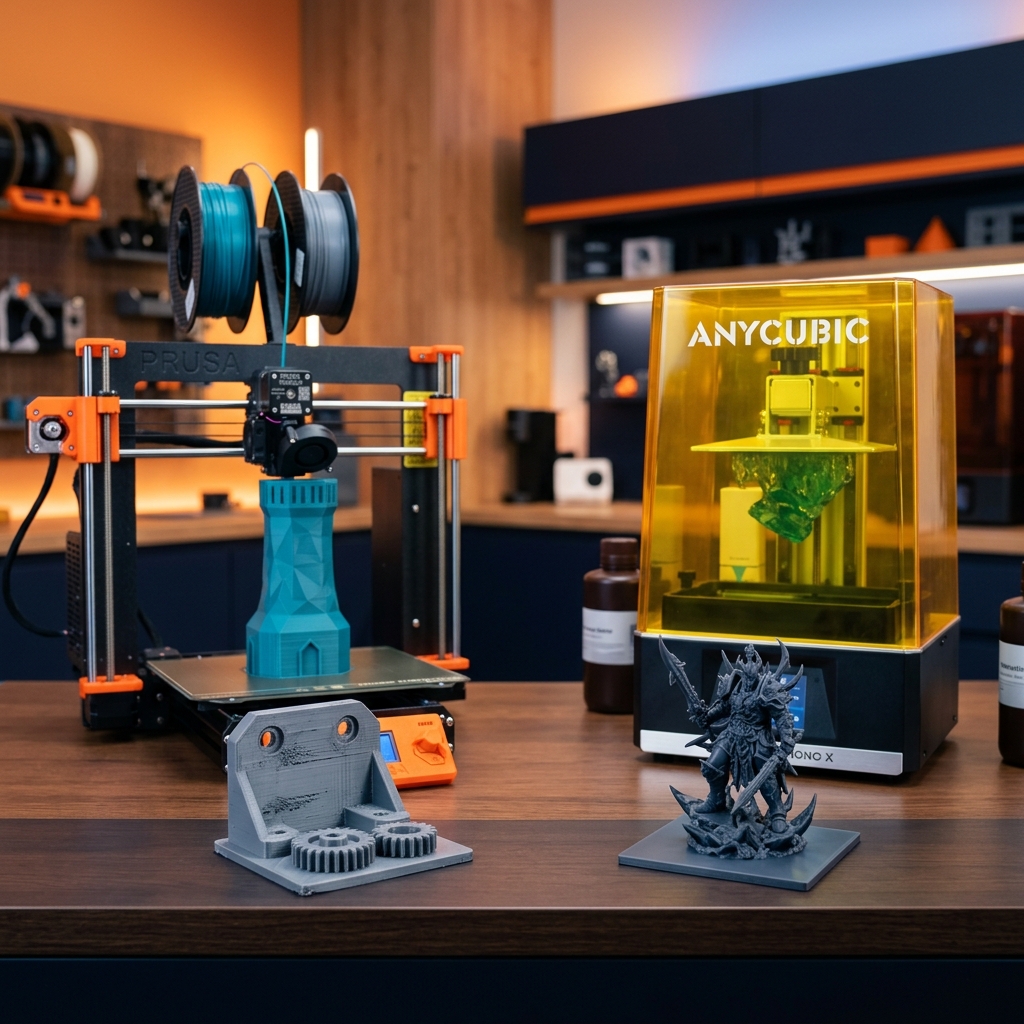
- ✓ Choose FDM (Filament) for 90% of household, mechanical, cosplay, and functional prototyping needs—it is odor-safe with PLA/PETG, requires zero chemical washing, and builds tough parts.
- ✓ Choose MSLA (Resin) when microscopic surface detail under 50 microns is non-negotiable: 28mm tabletop miniatures, dental arches, jewelry casting masters, and smooth collectible statues.
- ✓ True Per-Gram Cost Gap: While 1 kg of PLA filament ($15) and 1 kg of standard photopolymer resin ($22) look similarly priced, mandatory IPA solvent, nitrile gloves, paper towels, and ACF/PFA vat film replacements add $0.45 to $0.85 of hidden consumable overhead to every resin build plate.
- ✓ Batch Speed Advantage: FDM print time scales with total plastic volume across the plate, whereas MSLA resin print time depends strictly on Z-height—printing 20 miniatures takes the exact same time as printing 1 miniature.
- ✓ Resin Safety Mandate: Liquid photopolymer resins contain sensitizing acrylates and photoinitiators; never run a resin printer in a bedroom or unventilated living space without PPE and active exhaust.
Two Completely Different Technologies Sharing One Name
Although both machines sit on a workbench and turn digital STL files into physical objects, FDM (Fused Deposition Modeling / Fused Filament Fabrication) and MSLA (Masked Stereolithography Resin) share almost nothing in physics, chemistry, workflow, or cost structure. Buying the wrong technology for your intended hobby or business is the single most expensive mistake new makers make—often leading to either frustration over visible layer lines on tiny miniatures, or shock at the chemical handling required for liquid photopolymers.
Here is the fundamental mechanical divide in 2027:
- FDM (Filament Printing): Melts a solid 1.75 mm thermoplastic cord (such as PLA, PETG, TPU, or ASA) through a heated metal nozzle at 200°C–280°C and deposits it along X/Y toolpaths one continuous line at a time. When the plastic cools on the spring-steel PEI build plate, the part is 100% solid, non-toxic to touch, and ready to use immediately. Browse our top picks in the Budget FDM Printers and Mid-Range CoreXY Printers hubs.
- MSLA (LCD Resin Printing): Submerges an inverted aluminum build plate into a vat filled with liquid UV-curable photopolymer resin. Beneath the transparent vat film (FEP, PFA, or ACF) sits a monochrome 12K or 16K masking LCD screen backed by a 405 nm ultraviolet LED matrix. Every 1.5 to 2.5 seconds, the screen flashes a complete cross-sectional pixel mask, curing the entire layer simultaneously at 19-micron XY resolution. Explore our Resin 3D Printers Hub for current 12K/16K hardware.
Resolution, Dimensional Accuracy & Surface Quality
When people say resin printing looks "like injection molding," they are talking about voxel size (a 3D pixel). Let's compare the smallest physical feature each technology can resolve in 2027.
XY Pixel Size (14–19 Microns) vs Nozzle Orifice (200–400 Microns)
On an FDM printer equipped with a standard 0.40 mm (400-micron) nozzle, the nozzle cannot draw a sharp outside corner with a radius smaller than 200 microns, nor can it print an embossed letter narrower than ~380 microns. Even if you swap in a fine 0.20 mm (200-micron) nozzle and print at a 0.06 mm layer height (60 microns), the molten circular strand still leaves micro-ridges along shallow curved domes.
By contrast, a 2027 MSLA printer like the Elegoo Mars 5 Ultra (9K) or Elegoo Saturn 4 Ultra (12K/16K) achieves an XY pixel pitch of 18 × 18 microns to 19 × 24 microns (0.019 mm) and cures Z-layers as thin as 10 to 30 microns (0.01–0.03 mm). Because a human hair is roughly 70 microns thick, a 25-micron resin layer with 4x greyscale anti-aliasing is literally invisible to the naked eye—even after applying miniature primer and dry-brushing.
Mechanical Strength, Creep & UV Brittleness
Where MSLA wins on microscopic beauty, FDM dominates on structural engineering. FDM thermoplastics are long-chain semi-crystalline or amorphous polymers that retain high impact toughness, flexural fatigue life, and thermal stability:
- Toughness & Drop Resistance: A PLA+ or PETG drill battery mount dropped from 2 meters onto concrete bounces off unscathed. A standard resin print dropped from waist height shatters like porcelain unless formulated with expensive ABS-Like or Tough engineering resins ($32–$55/kg).
- Creep Under Constant Load: If you bolt two parts together under constant clamping tension, cured photopolymer resins experience viscoelastic creep—slowly bowing or cracking around screw bosses over weeks. FDM PETG, ASA, and PA-CF (Carbon Fiber Nylon) hold mechanical torque indefinitely.
- Dimensional Shrinkage & Warping: Photopolymer resins shrink by 1.5% to 3.5% by volume during UV polymerization and post-curing, which makes long flat mechanical boxes prone to banana-curling compared to an enclosed CoreXY FDM printer like the Bambu Lab P1S.
| Engineering Metric | 2027 FDM (Filament) | 2027 MSLA (12K/16K Resin) | Winner |
|---|---|---|---|
| Minimum XY Feature Size | 200–400 microns (0.2–0.4 mm nozzle) | 18–24 microns (0.019 mm LCD pixel) | MSLA Resin (10x Finer) |
| Typical Layer Height (Z) | 80–280 microns (0.08–0.28 mm) | 20–50 microns (0.02–0.05 mm) | MSLA Resin |
| Impact Strength (Izod Notched) | High (PLA+, PETG, ASA, TPU, Nylon) | Low (Standard) / Moderate (ABS-Like) | FDM Filament |
| Heat Deflection Temp (HDT) | 55°C (PLA) up to 160°C (PA-CF / PC) | 50°C–65°C (Std) unless High-Temp Resin | FDM Filament |
| Max Build Volume (Consumer) | 256³ mm to 350³ mm (K2 Plus) | 218 × 122 × 260 mm (10-inch Mid-Size) | FDM Filament |
| Post-Processing Time/Print | 1–3 minutes (pop off PEI, snip brims) | 15–25 minutes (Gloves, IPA wash, UV cure) | FDM Filament |
| Single-Part Print Speed | Very Fast (150–350 mm/s CoreXY) | Moderate (Z-height dependent: 70–150 mm/h) | FDM Filament |
| Full-Plate Batch Speed (20 items) | Slow (scales linearly with part count) | Ultra-Fast (cures entire plate at once!) | MSLA Resin |
The True Cost of FDM vs Resin: Exposing Hidden Consumables
Beginners frequently look at Amazon prices—seeing 1 kg of PLA filament for $16.99 and 1 kg of Standard Photopolymer Resin for $21.99—and assume resin printing only costs 30% more than filament printing. That calculation ignores four mandatory resin consumable streams. You can model both FDM and Resin consumables side by side in our 3D Print Cost Calculator.
Upfront Hardware Ecosystem Cost
When you buy an FDM printer like the Bambu Lab A1 Mini ($199) or Bambu Lab A1 ($339), the box contains everything required to produce finished parts. When you buy a resin printer like the Elegoo Mars 5 Ultra (~$269) or Elegoo Saturn 4 Ultra (~$399), you must also purchase a two-stage Wash & Cure Station ($99–$139), a silicone slap mat ($12), a 100-pack of 6-mil nitrile gloves ($14), 1 gallon of 99% Isopropyl Alcohol ($26), safety glasses ($10), and an organic-vapor respirator + ventilation ducting ($45–$75). That adds $190 to $260 in mandatory day-one equipment before you cure your first drop of resin.
Per-Print Consumables: IPA, Nitrile Gloves, ACF Film & LCD Lifespan
Every time you run a resin print job, your true variable cost includes:
- Uncured Resin Drag-Out Waste (+8% to +15%): Even after dripping for 10 minutes, hollow chambers, dense miniature tree supports (which account for 25%–40% of sliced resin volume), and build plate surfaces carry a film of uncured liquid resin directly into your IPA wash bucket, where it is dissolved and lost forever.
- 99% Isopropyl Alcohol (IPA) Saturation (~$0.28/plate): One gallon (3.78 liters) of 99% IPA ($26) can wash roughly 80 to 100 prints before becoming gummy with dissolved oligomers, requiring solar recycling and fresh solvent top-ups.
- Nitrile Gloves & Shop Towels (~$0.24/plate): You will use at least one pair of heavy-duty nitrile gloves ($0.18) plus lint-free paper towels ($0.06) during plate removal, support stripping, and vat inspection.
- Vat Release Film (FEP / PFA / ACF) & Mono LCD Screen Depreciation (~$0.32/plate): An ACF or PFA release sheet ($8.50) lasts roughly 40 prints ($0.21/print), and the $95 monochrome masking LCD screen is a consumable component rated for ~2,000 exposure hours (adding ~$0.11/print).
| Cost Component | FDM Print (100g Net Model) | MSLA Resin Print (100g Net Model) |
|---|---|---|
| Base Material Price | $16.00 / kg (PLA+) | $28.00 / kg (ABS-Like 8K Resin) |
| Model + Support + Drag-Out Mass | 112 g (12% support/brim) | 142 g (30% dense supports + 12% liquid drag-out) |
| Raw Material Cost | $1.79 | $3.98 |
| IPA Solvent + Nitrile Gloves + Towels | $0.01 (wipe PEI w/ 1 ml IPA) | $0.52 (IPA bath degradation + 1 pair gloves) |
| Vat Film (ACF/FEP) + LCD / Nozzle Wear | $0.03 (hardened nozzle wear) | $0.32 (ACF film + Mono LCD screen hours) |
| Electricity (Printer + Wash/Cure) | $0.09 (3.2 hrs @ 175W) | $0.05 (2.0 hrs @ 95W + 20m Wash/Cure) |
| True Total Cost Per 100g Output | $1.92 | $4.87 (2.53x More Expensive) |
Safety, VOC Fumes & Chemical Disposal Protocols
Safety is the single biggest lifestyle differentiator between FDM and MSLA printing. Read our detailed breakdown of air quality in 12 Essential 3D Printing Accessories.
Why Liquid Photopolymers Are Skin Sensitizers
Liquid 3D printing resin consists of methacrylated monomers, urethane oligomers, and UV photoinitiators (such as TPO or BAPO). Unlike household glues where irritation fades once washed off, uncured acrylates are immune sensitizers. Each time uncured resin or resin-contaminated IPA touches your bare skin, your immune system builds T-cell memory against acrylate compounds. After months of careless handling, you can cross an irreversible threshold into allergic contact dermatitis—where even trace vapor or cured dust triggers severe blistering rashes across your hands and forearms.
Mandatory 5-Rule Resin Safety Checklist
- Never Touch Uncured Resin or Contaminated IPA Bare-Handed: Wear 6-mil disposable nitrile gloves (never latex, which acrylates penetrate in minutes).
- Ventilate to the Outdoors: Keep the resin printer and wash bucket inside a grow tent or enclosure with negative-pressure inline ducting out a window. Internal carbon blocks alone saturate quickly during IPA washing.
- Remove Supports BEFORE Final UV Post-Curing: Soak the washed print in warm water (42°C) for 60 seconds after the IPA bath; supports peel off like soft rubber without sending sharp flying shards across your room.
- Wear Eye Protection When Snipping Supports: A single drop of uncured resin trapped inside a hollow miniature splashing into an eye is a medical emergency.
- Cure All Waste Before Trash Disposal: Place used gloves, paper towels, peeled supports, and dirty IPA sludge trays in direct sunlight (or under your UV cure lamp) until rock-hard and inert before placing in household trash.
3 Real-World Numerical Case Studies: FDM vs Resin Head-to-Head
Let's evaluate three real production scenarios with complete unit economics to see which technology wins.
Case Study 1: A 20-Model Squad of 32mm Tabletop Wargaming Miniatures
You want to print a 20-unit squad of 32mm heroic-scale infantry miniatures (each model is 38 mm tall and weighs 4.2 grams net, or 84 grams total for the squad).
- MSLA Resin (Elegoo Saturn 4 Ultra, 0.03 mm layers, ABS-Like Resin @ $26/kg): All 20 miniatures fit easily on a single build plate! Because Z-height is only 44 mm (angled at 35° on supports), the entire batch of 20 models prints in 1 hour 22 minutes! Total resin consumed (including supports and drag-out): 126g ($3.28) + $0.84 in IPA/gloves/ACF/electricity = $4.12 total ($0.206 per miniature) with museum-grade 19-micron detail.
- FDM Filament (Bambu Lab A1 Mini with 0.2 mm nozzle, 0.06 mm layers, PLA+ @ $18/kg): Printing 1 miniature takes 1 hour 18 minutes, so printing 20 miniatures sequentially takes 25 hours 40 minutes! Total material + power cost is only $2.35 ($0.118 per miniature), but it takes 18.7x longer and requires tedious tree-support removal around delicate spears. Winner: MSLA Resin by a landslide.
Case Study 2: Functional 180g Cordless Drill Wall-Mount Bracket
You need 4 heavy-duty garage wall mounts that hold a 2.4 kg impact driver and withstand summer garage temperatures of 48°C.
- FDM Filament (Bambu Lab P1S, 0.4 mm nozzle, 0.20 mm layers, PETG @ $16/kg): Prints all 4 brackets (720g total) in 8 hours 15 minutes. Zero chemical post-processing, survives 70°C garage heat, holds 35 kg load without creeping. Total cost for 4 brackets: $12.10 ($3.02 each).
- MSLA Resin (Tough Engineering Resin @ $48/kg): Requires heavy supports that mar the flat mounting surface, takes 2 full plates due to XY footprint, and costs $46.80 ($11.70 each) while still risking brittle fracture if struck by the metal drill chuck. Winner: FDM Filament by a landslide.
Case Study 3: Full-Scale Wearable Mandalorian Cosplay Helmet (780g)
- FDM Filament (Bambu Lab A1, 256×256×256 mm bed, Lightning Infill): Prints the entire helmet dome in one piece in 16 hours 40 minutes using 780g of PLA+ ($12.48 material + $0.45 electricity = $12.93 total). Lightweight, impact-resistant, and skin-safe to wear inside all day at a convention.
- MSLA Resin: Must be sliced into 4 to 6 pieces on most mid-size resin printers, weighs over 1,100g, costs $38+ in resin and consumables, and requires full interior epoxy sealing so sweat does not leach residual monomers against the wearer's face. Winner: FDM Filament.
The Verdict: Decision Matrix & When to Own Both
Quick Buyer Selection Formula (FDM vs MSLA Resin)
If you are buying your first 3D printer and want to print functional household organizers, board game box inserts, cosplay props, workshop jigs, articulated toys, and tabletop terrain, start with a modern high-speed FDM printer from our Best 3D Printer for Beginners (2027) Guide. If your sole passion is painting 28mm–75mm Warhammer/D&D miniatures, sculpting collectible anime statues, or casting jewelry, jump straight to our Resin 3D Printers Hub and budget an extra $200 for a Wash & Cure station and proper ventilation.
*Pricing Note: All dollar figures listed in our 2027 guides represent estimated manufacturer reference MSRPs or measured lab electricity/filament averages at the time of testing. Click any Amazon button to verify live pricing and stock.
Frequently Asked Questions (2027 FAQ)
Can a 0.2 mm nozzle on a 2027 FDM printer replace a resin printer for miniatures?
A 0.2 mm nozzle on a high-precision FDM printer like the Bambu Lab A1 Mini printing at 0.06 mm layer height produces impressive tabletop-ready monsters, terrain, and vehicles. However, a 12K or 16K MSLA resin printer with 19-micron XY pixels still captures microscopic facial expressions, chainmail rings, and thin swords without support scarring that FDM cannot physically replicate.
Is resin 3D printing safe in an apartment or spare bedroom?
Only if you isolate the printer and wash station inside an actively ventilated enclosure ducted directly out a window using a 4-inch inline fan, and wear nitrile gloves and safety glasses during every handling step. Uncured liquid resin is a cumulative skin sensitizer that can trigger permanent allergic contact dermatitis upon repeated bare-skin exposure.
Does Water-Washable resin eliminate the safety hazards of resin printing?
No. Water-Washable resin eliminates the need to buy flammable 99% Isopropyl Alcohol (IPA), but the contaminated wash water contains dissolved toxic acrylates and photoinitiators. You must never pour resin wash water down a household sink or storm drain, as it is acutely toxic to aquatic life; it must be evaporated and UV-cured in sunlight before disposal.
How often do you have to replace the FEP, PFA, or ACF film on a resin printer?
Standard FEP and PFA (nFEP) release films typically last 30,000 to 60,000 layer peel cycles (roughly 25 to 50 full prints) before developing cloudy tension marks or micro-indentations. High-speed ACF (Advanced Composite Film) supports faster peel speeds on tilting-vat printers like the Elegoo Saturn 4 Ultra and averages $6 to $9 per replacement sheet.
Why are standard resin 3D prints so brittle compared to PLA or PETG filament?
Standard UV photopolymer resins cure into tightly cross-linked thermoset acrylic networks that have high compressive stiffness but very low elongation at break (often only 3% to 6%), causing them to shatter like glass when dropped on a hard floor. Mixing 80% ABS-Like Resin with 20% Tenacious Flexible Resin boosts impact resistance dramatically.
Which technology is cheaper to start in 2027: FDM or MSLA Resin?
FDM is roughly $120 to $160 cheaper to start. You can buy a Bambu Lab A1 Mini ($199) and two spools of PLA ($30) and start printing immediately for $229 total. A $269 resin printer requires a $110 Wash & Cure station, $25 in 99% IPA, $18 in nitrile gloves/respirator cartridges, and $25 resin—totaling $447+ on day one.
Related 2027 Guides
Calculate Your True Cost Per Print
Model filament weight, multi-color AMS purge waste, local kWh electricity rates, and Etsy profit margins in our interactive calculator.