PLA vs PETG vs ABS vs ASA vs TPU (2027): Filament Strength & Cost Guide
Compare PLA, PETG, ABS, ASA, and TPU filaments in 2027: tensile strength, heat deflection, moisture control, nozzle temperatures, and real cost per gram.
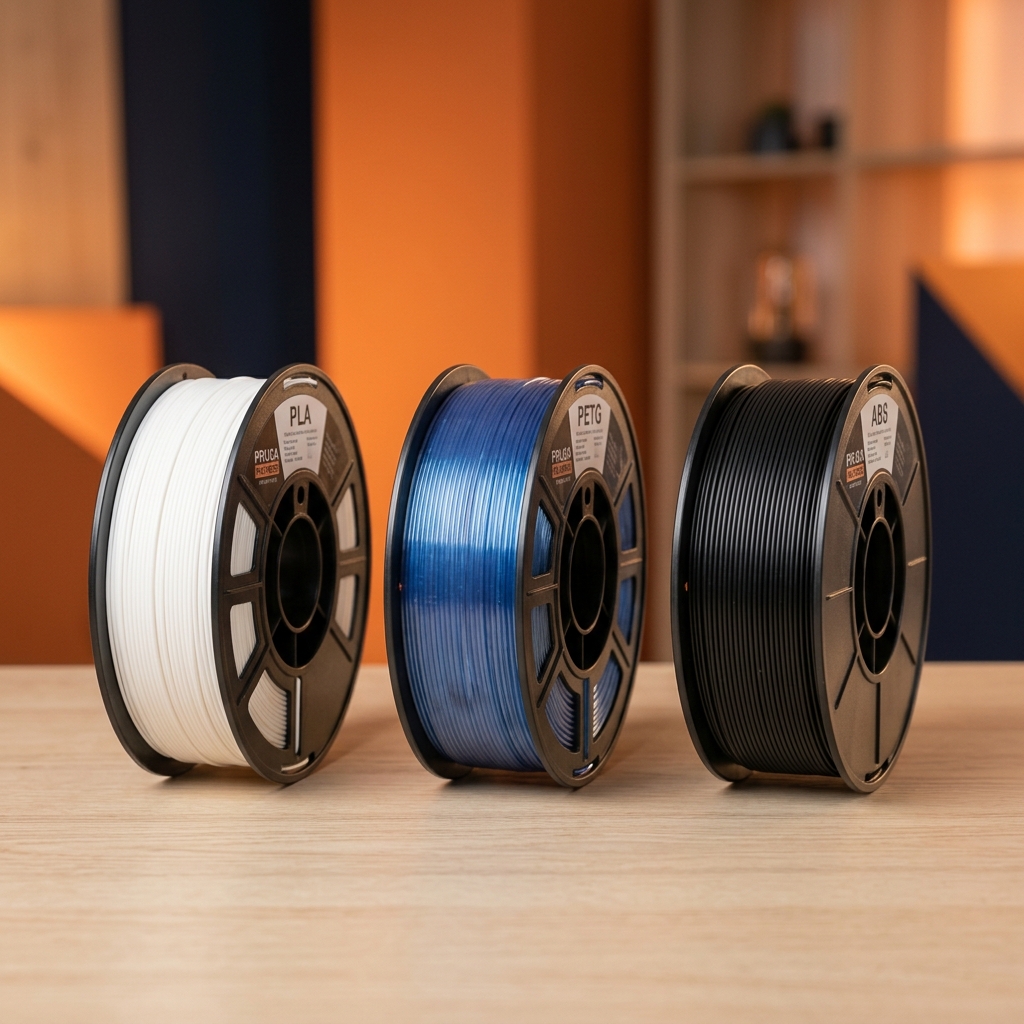
- ✓ Standard PLA actually has higher ultimate tensile strength (58–65 MPa) and stiffness than PETG or ABS, but its low 52–56°C Heat Deflection Temperature (HDT) causes it to warp inside a summer car cabin within 20 minutes.
- ✓ PETG ($15–$20/kg) is the best all-around functional filament for open-frame printers, offering ductile impact resistance, chemical stability, and a 68–74°C HDT—provided you dry it at 65°C for 6 hours before printing.
- ✓ In 2027, ASA has largely replaced legacy ABS for structural and outdoor engineering parts because its acrylate rubber modifier prevents UV yellowing and reduces warping while sustaining a 95–102°C heat deflection threshold.
- ✓ True cost per cubic centimeter (cm³) differs from cost per kilogram ($/kg) because material density varies from 1.04 g/cm³ for ABS to 1.27 g/cm³ for PETG—meaning a 1 kg spool of ABS yields 18.5% more printed volume than 1 kg of PETG.
- ✓ Enclosure heating and bed temperatures dramatically impact electricity cost: printing ABS/ASA at a 105°C bed temperature consumes 2.2× to 2.6× more electrical watt-hours per print than PLA on a 55°C build plate.
Choosing the wrong 3D printer filament is the fastest way to ruin an otherwise well-designed mechanical part. Every week, makers spend 12 hours printing a custom automotive cup-holder adapter in standard PLA, only to return to their car after lunch and find a wilted Dali-esque sculpture sagged across the center console. Conversely, beginners often torture themselves trying to print large decorative organizers out of warp-prone ABS when Tough PLA+ would have printed twice as fast with zero toxic fumes and higher structural stiffness.
In this 2027 engineering materials guide, we move past vague generalizations ("PLA is easy, ABS is strong") and examine empirical polymer testing data: XY vs Z-axis tensile strength (MPa), Charpy notched impact toughness (kJ/m²), Heat Deflection Temperature (HDT at 0.45 MPa in °C), specific gravity (g/cm³), moisture absorption kinetics, and true cost per cubic centimeter calculated with our 3D Print Cost Calculator.
Master Mechanical & Thermal Comparison Table (2027)
All mechanical figures below reflect FFF 3D-printed test specimens (ASTM D638 Type I tensile bars and ISO 179 Charpy impact bars printed flat on the XY plane with a 0.4 mm nozzle, 0.20 mm layer height, and 100% rectilinear infill), alongside Z-axis interlayer adhesion ratios.
| Material Type | Density (g/cm³) | XY Tensile Strength | Z-Axis Layer Strength | Charpy Impact (kJ/m²) | HDT @ 0.45 MPa | Nozzle / Bed Temp (°C) | Enclosure Needed? |
|---|---|---|---|---|---|---|---|
| Standard PLA | 1.24 | 59 MPa | 34 MPa | 3.2 kJ/m² | 54 °C | 205–220 / 55–60 | No (Door open) |
| PLA+ / Tough PLA | 1.23 | 52 MPa | 38 MPa | 7.8 kJ/m² | 56 °C | 215–230 / 60 | No |
| Rapid PETG | 1.27 | 47 MPa | 31 MPa | 8.4 kJ/m² | 71 °C | 235–255 / 70–80 | Optional |
| Standard ABS | 1.04 | 41 MPa | 24 MPa | 13.5 kJ/m² | 96 °C | 245–265 / 95–105 | Yes (45°C+ Chamber) |
| Engineering ASA | 1.07 | 44 MPa | 27 MPa | 12.1 kJ/m² | 99 °C | 250–270 / 95–105 | Yes (45°C+ Chamber) |
| TPU 95A (Flexible) | 1.21 | 32 MPa | 29 MPa | No Break (Elastomer) | 64 °C | 220–235 / 45–60 | No (Direct Drive) |
Deep Dive by Polymer: Strengths, Failure Modes & Slicer Settings
1. PLA & High-Speed PLA+: The Misunderstood Stiffness Champion
One of the biggest myths in desktop manufacturing is that Polylactic Acid (PLA) is "weak." In laboratory tensile pull tests, standard PLA registers an ultimate tensile strength of 58 to 65 MPa and a Young's modulus (stiffness) of 3,100 to 3,500 MPa—significantly stiffer and stronger under static tension than PETG (47 MPa) or ABS (41 MPa). If you need a rigid camera mount or router jig that must not flex under load at room temperature, PLA actually outperforms unreinforced ABS.
Why, then, do engineers hesitate to use PLA for critical mechanical parts? It has three distinct polymer weaknesses:
- Brittle Fracture Mechanics: Standard PLA elongates less than 4% before snapping catastrophically like dry spaghetti. Modern PLA+ / Tough PLA blends in elastomeric impact modifiers that raise Charpy impact resistance from 3.2 kJ/m² to 7.8 kJ/m² at a slight penalty to peak stiffness.
- Low Glass Transition Temperature (Tg ≈ 58°C): Above 54°C, PLA loses structural integrity rapidly. Never use it in dishwashers, car interiors, PC exhaust shrouds, or hot-climate outdoor enclosures.
- Mechanical Creep Under Constant Stress: If you bolt a PLA bracket under continuous clamping tension or hang a 10 kg weight from a PLA hook for six months, the polymer chains slowly slide past one another (cold flow/creep), loosening the joint over time.
2. PETG & High-Flow Rapid PETG: The Everyday Functional Workhorse
Polyethylene Terephthalate Glycol (PETG) takes the base polyester chemistry of a disposable water bottle (PET) and modifies it with cyclohexanedimethanol (glycol) to prevent crystallization during cooling. That glycol modification reduces shrinkage to less than 0.3%, allowing you to print large 250 mm structural parts on open-frame printers like the Bambu Lab A1 or Creality Ender 3 V3 KE without an enclosure.
In 2026 and 2027, filament manufacturers introduced Rapid / High-Speed PETG formulations that lower melt viscosity at high shear rates. While legacy PETG maxed out around 11–13 mm³/s volumetric flow (limiting print speed to ~110 mm/s), Rapid PETG sustains 20 to 24 mm³/s at 250°C, matching standard PLA print times while holding up to 71°C heat, outdoor rain, alcohols, oils, and weak acids.
3. ABS vs ASA: High-Temperature & Outdoor Engineering
When your part lives inside an engine bay, a summer vehicle cabin, a 3D printer toolhead shroud (like a Voron StealthBurner), or on a sunlit backyard fence post, neither PLA nor PETG will survive. You need a styrene-based amorphous engineering copolymer: Acrylonitrile Butadiene Styrene (ABS) or Acrylonitrile Styrene Acrylate (ASA).
In 2027, ASA has superseded ABS for roughly 80% of functional applications. Why? Both share nearly identical heat deflection temperatures (~96–99°C) and acetone vapor-smoothing compatibility, and both exhibit high thermal contraction (~0.6–0.8% linear shrinkage) that requires an enclosed CoreXY printer like the Bambu Lab P1S, Creality K1C, or Qidi Plus 4. However, ASA replaces the UV-sensitive butadiene rubber in ABS with a saturated acrylic ester rubber phase. Left outdoors in Arizona sunlight for 1,000 hours, ABS loses over 50% of its impact strength and chalks yellow; ASA retains over 92% of its mechanical toughness and surface gloss.
4. TPU (Thermoplastic Polyurethane 95A / 85A): Indestructible Elastomer
TPU is a block copolymer featuring alternating hard and soft segments, measured on the Shore hardness scale (95A is comparable to a skateboard wheel or shopping cart tire; 85A feels like a running shoe sole). What many makers overlook is that TPU possesses the highest interlayer (Z-axis) bond strength and abrasion resistance of any consumer filament. For drone camera bumpers, RC car suspension arms, tool handle grips, vibration dampers, and custom gaskets, 95A TPU is virtually indestructible.
The golden rule for TPU is volumetric speed restraint and moisture elimination: keep volumetric flow between 3.2 and 5.5 mm³/s (roughly 40–70 mm/s print speed at 0.20 mm layers) so the flexible filament does not buckle inside the extruder drive gears, and feed it directly rather than through long PTFE multi-material tubes.
The Hidden Economic Metric: Cost Per Gram ($/g) vs Cost Per Cubic Centimeter ($/cm³)
Your slicer slices models by volume (cm³), not by weight. Yet filament is sold by weight (1 kg = 1,000 g). Because ABS (1.04 g/cm³) and ASA (1.07 g/cm³) are ~18% less dense than PETG (1.27 g/cm³) and PLA (1.24 g/cm³), an identical CAD part weighs significantly less when printed in ABS or ASA!
Volumetric Filament Cost Formula
Cost per cm³ ($/cm³) = (Spool Price per kg ÷ 1,000) × Material Density (g/cm³)
| Filament Material | Avg 2027 Spool Price ($/kg) | Price per Gram ($/g) | Density (g/cm³) | Volume per 1 kg Spool (cm³) | True Cost per cm³ ($/cm³) | Weight of a 100 cm³ Part |
|---|---|---|---|---|---|---|
| Bulk High-Speed PLA | $13.99 | $0.0140/g | 1.24 g/cm³ | 806 cm³ | $0.0173 / cm³ | 124.0 g ($1.73) |
| PLA+ / Tough PLA | $18.99 | $0.0190/g | 1.23 g/cm³ | 813 cm³ | $0.0234 / cm³ | 123.0 g ($2.34) |
| Rapid PETG | $15.99 | $0.0160/g | 1.27 g/cm³ | 787 cm³ | $0.0203 / cm³ | 127.0 g ($2.03) |
| Standard ABS | $17.99 | $0.0180/g | 1.04 g/cm³ | 962 cm³ | $0.0187 / cm³ | 104.0 g ($1.87) |
| Weatherproof ASA | $24.99 | $0.0250/g | 1.07 g/cm³ | 935 cm³ | $0.0267 / cm³ | 107.0 g ($2.67) |
| TPU 95A Elastomer | $26.99 | $0.0270/g | 1.21 g/cm³ | 826 cm³ | $0.0327 / cm³ | 121.0 g ($3.27) |
3 Real-World Numerical Case Studies: Material Selection & Total Cost
Let's model the exact same 85 cm³ mechanical enclosure bracket printed across three different polymer families to see how density, volumetric flow limits, heated bed wattage, filament drying, and failure rates alter total part cost. You can replicate these exact numbers in our How Much Does 3D Printing Cost? guide or live on the Cost Calculator.
Case Study 1: Indoor Router Mount Bracket in High-Speed PLA+ (85 cm³ Volume)
Printed on a Bambu Lab A1 at 220°C nozzle / 60°C bed at 21 mm³/s volumetric flow ($0.11/hr machine depreciation).
- Part Mass & Material Cost: 85 cm³ × 1.23 g/cm³ = 104.55 g (+ 2.5 g purge = 107.05 g) × $0.019/g = $2.034.
- Print Time & Electricity: 2 hours 15 minutes (2.25 hrs) at 95W average draw = 0.214 kWh × $0.16/kWh = $0.034.
- Depreciation & Wear: 2.25 hrs × $0.11/hr = $0.248.
- Failure Adjustment (1.8% PLA+ failure rate): ($2.034 + $0.034 + $0.248) × 1.018 = $2.36 total cost.
Case Study 2: Outdoor Solar Weather Station Mount in ASA (85 cm³ Volume)
Printed on an enclosed Bambu Lab P1S at 260°C nozzle / 100°C bed with a 15-minute chamber heat-soak ($0.18/hr machine depreciation).
- Part Mass & Material Cost: Because ASA has a density of 1.07 g/cm³, the exact same 85 cm³ bracket weighs only 90.95 g (+ 6.5 g brim/purge = 97.45 g) × $0.025/g = $2.436.
- Print Time, Pre-Heat & Electricity: 2.65 hours active printing + 0.25 hr chamber pre-heat = 2.90 hrs at 215W average draw (100°C bed draws over double the wattage of a 60°C bed) = 0.624 kWh × $0.16/kWh = $0.100.
- Filament Drying Energy: 4 hours in a 70°C dryer at 48W (divided across 2 parts on the spool) = 0.096 kWh × $0.16 = $0.015.
- Depreciation & Wear: 2.90 hrs × $0.18/hr = $0.522.
- Failure Adjustment (4.5% ASA warp risk): ($2.436 + $0.100 + $0.015 + $0.522) × 1.045 = $3.21 total cost. For an extra $0.85 over PLA+, you gain UV immunity and a 99°C thermal ceiling.
Case Study 3: Vibration-Damping Shop-Vac Hose Adapter in 95A TPU (85 cm³ Volume)
Printed on a Creality K1C fed from a top-mounted active dryer at 228°C nozzle / 50°C bed, capped at 4.5 mm³/s volumetric speed ($0.16/hr machine depreciation).
- Part Mass & Material Cost: 85 cm³ × 1.21 g/cm³ = 102.85 g (+ 2.0 g skirt = 104.85 g) × $0.027/g = $2.831.
- Print Time & Electricity: Because TPU is speed-limited to 4.5 mm³/s to avoid extruder buckling, print time increases to 6 hours 30 minutes (6.50 hrs) at 78W average draw (50°C bed) + 45W continuous dryer draw = 123W × 6.50 hrs = 0.800 kWh × $0.16/kWh = $0.128.
- Depreciation & Wear: 6.50 hrs × $0.16/hr = $1.040.
- Failure Adjustment (3.2% TPU jam risk): ($2.831 + $0.128 + $1.040) × 1.032 = $4.13 total cost. Notice how TPU's slow volumetric speed makes machine time ($1.04) nearly 4× higher than PLA's machine time ($0.25)!
Hygroscopic Moisture Management & Drying Protocol
Polyesters (PLA, PETG) and polyurethanes (TPU) undergo hydrolysis when heated in the presence of water molecules: water steam inside the 240°C melt zone literally cleaves polymer chains into shorter segments, reducing Z-axis layer strength by up to 32% while causing fuzzy surface artifacts. Follow our dedicated Best Filament Dryer Guide (2027) and use these exact thermal schedules:
Verified Filament Drying Schedule & Storage Checklist
- PLA / PLA+: Dry at 50°C for 4–6 hours (never exceed 55°C or the filament will soften and fuse together on the spool).
- PETG / Rapid PETG: Dry at 65°C for 6 hours before printing; store in sealed bags or dryboxes with color-indicating orange silica gel below 20% RH.
- ABS / ASA: Dry at 70–75°C for 6 hours to prevent micro-bubbling along seam lines.
- TPU 95A / 85A: Extremely hygroscopic—dry at 65°C for 8 hours and print directly out of the heated dryer box via a PTFE feed port.
Nozzle Wear, Build Plate Compatibility & Release Chemistry
Even if you dial in your nozzle temperatures and moisture drying perfectly, pairing the wrong polymer with the wrong build surface or nozzle metallurgy will destroy consumables prematurely and inflate your per-part maintenance budget.
1. Smooth PEI vs Textured PEI vs CryoGrip Cool Plates
Standard PLA bonds cleanly to both smooth PEI sheets and powder-coated textured PEI plates at 55–60°C, and in 2027 many print farms use polyurethane-coated cool plates (like the BIQU CryoGrip at 35°C) to cut heated-bed electricity consumption by 45%. However, PETG and TPU form aggressive chemical bonds with smooth PEI that can rip chunks of polyetherimide coating right off the spring steel sheet upon removal. Always print PETG and TPU on textured powder-coated PEI or apply a thin sacrificial film of liquid PVP glue or hairspray as a release agent.
2. Brass vs Hardened Steel vs ObXidian Nozzles for Matte & CF Blends
While pure unpigmented PLA, PETG, and ASA cause negligible nozzle wear over 1,000 printing hours, matte filaments, white filaments (heavily loaded with titanium dioxide TiO₂ pigment), glow-in-the-dark strontium aluminate, and 15% chopped carbon-fiber blends (PLA-CF, PETG-CF, ASA-CF) act like liquid sandpaper. A standard $2 brass 0.4 mm nozzle will bore out to 0.55 mm after just 600 grams of glow-in-the-dark PLA. Upgrading your printer to a hardened tool-steel or tungsten-carbide 0.4 mm nozzle eliminates dimensional drift across thousands of hours.
Indoor Air Quality, VOC Emissions & Ventilation Guidelines
Different thermoplastics release vastly different airborne concentrations of Ultrafine Particles (UFPs, <100 nm) and Volatile Organic Compounds (VOCs) during extrusion. Understanding these emissions determines where you can safely place your printer.
3. Lactide vs Styrene & Acrylate Fume Contagion
PLA and PETG emit low levels of methyl methacrylate and lactide vapor—generally safe for occupied home offices with basic room air turnover. By contrast, printing ABS at 255°C or ASA at 265°C volatilizes monomer styrene and acrylonitrile particulates that cause headaches, mucous membrane irritation, and distinct burnt-plastic odors. Always run ABS and ASA inside an enclosed chamber equipped with a recirculating activated-carbon and HEPA 13 filter or ducted out a window.
Quick Material Selection Decision Matrix
- Choose High-Speed PLA / PLA+ when: You want maximum stiffness, crisp overhangs, fast 22+ mm³/s printing, low electricity draw, and the part stays indoors below 50°C.
- Choose Rapid PETG when: You need water resistance, snap-fit flexibility, mechanical toughness up to 70°C, and low-odor printing on an open or enclosed machine.
- Choose ASA when: The part faces direct outdoor UV sunlight, car dashboard temperatures up to 99°C, or structural engine-bay environments.
- Choose 95A TPU when: You need shock absorption, non-slip feet, flexible hinges, gaskets, or puncture-proof abrasion resistance.
Want to compare specific filament brands or calculate how switching from PLA to PETG or ASA affects your part margins? Run your exact gram weight and electricity rate in our 3D Print Cost Calculator or explore our Filament Database.
*Pricing Note: All dollar figures listed in our 2027 guides represent estimated manufacturer reference MSRPs or measured lab electricity/filament averages at the time of testing. Click any Amazon button to verify live pricing and stock.
Frequently Asked Questions (2027 FAQ)
Is PETG stronger than PLA for functional 3D printed brackets?
PLA has higher static stiffness and tensile strength (60 MPa vs 48 MPa for PETG), meaning PLA resists bending better under a steady load. However, PLA fails brittlely by snapping without warning, whereas PETG has 2.5× higher Charpy impact toughness and bends ductilely under shock loads or outdoor temperature swings.
Why did my PLA print melt and warp inside my car on a sunny day?
Standard PLA has a glass transition temperature (Tg) of 55–60°C and a Heat Deflection Temperature (HDT at 0.45 MPa) of roughly 54°C. A parked car dashboard in direct summer sunlight easily reaches 70–85°C, causing PLA polymer chains to relax and deform. Use ASA (98°C HDT) or high-temp PETG/ABS for automotive parts.
Should I use ABS or ASA for outdoor 3D prints in 2027?
Always choose ASA over ABS for outdoor applications. ABS contains polybutadiene rubber whose carbon-carbon double bonds degrade rapidly under ultraviolet (UV) sunlight, turning brittle and yellow within months. ASA replaces butadiene with saturated acrylic ester elastomer, maintaining mechanical impact strength and color stability for years outdoors.
Why does PETG string so much and stick too hard to PEI build plates?
PETG is highly hygroscopic and has lower melt viscosity elasticity than PLA. Absorbed moisture boils at 240°C inside the nozzle, creating pressure spikes that ooze fine hairs across travel moves. Additionally, PETG chemically bonds aggressively to smooth PEI; always print PETG on textured powder-coated PEI or apply a thin PVA glue-stick release layer.
Can a beginner open-frame printer like the Bambu Lab A1 print TPU and ASA?
An open-frame direct-drive printer like the Bambu Lab A1 prints 95A TPU and PETG effortlessly when fed directly from a spool holder (not through an AMS). However, printing ASA or ABS larger than 50 mm on an open-frame printer will result in severe corner warping and toxic styrene/acrylate odor; use an enclosed printer like the Bambu Lab P1S or Creality K1C.
Which filament gives the most printed parts per 1 kg spool?
ABS and ASA yield the most printed parts per 1 kg spool because their material density is only 1.04–1.07 g/cm³, compared to 1.24 g/cm³ for PLA and 1.27 g/cm³ for PETG. A 1,000-gram spool of ABS contains 961 cm³ of plastic versus 787 cm³ for PETG—giving you 22% more parts for the same spool weight.
Related 2027 Guides

Calculate Your True Cost Per Print
Model filament weight, multi-color AMS purge waste, local kWh electricity rates, and Etsy profit margins in our interactive calculator.